Monday, April 18, 2022

Crypt-Cities: Rot Blossom Beds

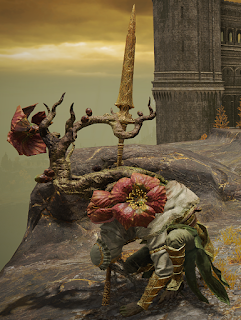
(I hadn't given my Crypt-Cities mini-setting much thought for over a year now. But somewhere during the lurid dream-quest that has been my first Elden Ring playthrough, I came across these guys.

Trying not to spoil much, they are undead guardians brought back to life by the miniature trees sticking out of their backs. Some are bare or budding, others are blooming, still others are suffering a fungal infection.

How could I not go back and write something similar up for CCs?)

Rot Blossom Beds

Ahh, here we are. Look upon this mound of rot and despair, all ye wretched Awakened.

This is the fate that awaits anyone who doesn't take the time to check their scabrous hides for sprouts at the end of the day. All that struggle, all that toil, all that Need doesn't amount to anything if you become just another mindless seedbed.

Fortunately for our demonstrational purposes, this poor wretch was taken by a less virulent strain of Rot Blossom. They're still doomed, make no mistake, but it affords us an opportunity to study it closer without fear of any of you lot succumbing- probably.

See here how the biggest growth erupts from between the shoulders- rot blossoms especially favor the spinal column as a pathway through the body when taking root. If this specimen was given the time to, it's likely it would grow into a hideously beautiful tree that would then spread its seeds all across the wastes, catching more Awakened and perpetuating the cycle.

It's almost enough to make you want to burn it, isn't it?

Of course that will only make things worse- for you, for the host, and for countless other Awakened. Instead, your best course of action will be to cut it down to size and then bury everything in pieces somewhere even more inhospitable than the rest of the wastes- a salt flat is ideal. Yes, you're damning your fellow to an eternity as an immobile salt mummy, but you'll be saving everyone else. Easy decisions do not await you in this unlife, Awakened.

See how the roots weave their way all along the body, even worming their way in under its death mask.  This allows it locomotion even after a point where the host's independent motor functions have long since ceased. The body is just another organ now, granting the plant the ability to move and see. The union is rarely perfect, and it can sometimes take seconds for stimuli to travel from one half to the other- that is what gives the rot-bedded their characteristic shamble; the thing so many of the Living characterize all of you having by default. It may be that these poor wretches originated that stereotype, but don't bear them any ill will for it if you can help it.

We may as well get this next part over with and show you lot how to neutralize them.

See how the body twitches and slowly gathers itself up as another creature approaches it. See the clumsy yet deliberate swivel as it tries to locate and react to this new threat.

See how it... waves its hand and clears its throat?

And... politely introduces itself?

What?


Not Just Fertilizer

It is difficult to call you "one of the lucky ones". You are an Awakened, after all. But considering the worse fate you should have suffered given the situation, it's safe to say you skirted another abyss. And look at you now; you've got a friend.

A less parasitic kind of rot blossom has taken root in your body. In fact, its relationship to you verges on symbiotic. You grant it life through your unfathomable biology, and in return it offers up its grim bounty. Perhaps it is a long-lost strain, or a more recent mutation. It may resemble a small flowerbed, a half-dead shrub, a tangle of vines, or even a gnarled sapling. Coloration ranges from matte and bland to eye-wateringly bright and lurid; texture from glassy smoothness to shredding thorns.

You resemble a Holt-Dweller whose mask has gone horribly awry, and among the unlearned you may even pass as one. But any Awakened worth heir smoke knows what you are, and will probably scorn you as such.

The plant will cause irreparable damage to your body if you try to remove it in its entirety, but you can prune it or keep it trimmed. Virtually every blossom bed that manages to keep the company of other Awakened will obsessively dispose of any fruit, seed pods, spore clusters, etc. before they can mature. Of course then you are left with company that is afraid of neither infestation nor immolation- a mad bunch indeed.

As alluded to, you can also use the 'bounty' of this bleak passenger to your own advantage. Branches can be cut and shaped into tools. Leaves can be harvested for their chemical properties. A seed can be used to hold yourself and anyone else in range of you hostage in a high-stakes situation. Your options are limited only by your imagination and recklessness.

You also benefit from something else. Something... disquieting to think about. You don't feel the Need quite as strongly as your fellows. The agonizing geas to throw yourself into a cozy little coffin in a crypt-city somewhere certainly still exists, but it doesn't have quite the same edge that drives others mad. This allows you to willingly travel farther afield of your final destination, opening up more opportunities to find resources and dangers out on the wastes.

But why exactly is the Need weaker in you?

Is it the rot blossom? Does it shield you from it?

Or is it feeding you a conflicting urge so subtle that you can't even perceive it?

And if so, where would it lead you?

Sunday, April 3, 2022

Goats & Gobs

Take a second to forget about all the animals you've seen domesticated (or not-so-domesticated) and ridden by goblins in the past. Forget about wargs. Forget ponies, or bats, or rat-dogs, or squigs, or llamas.

Well, okay, just put a pin in llamas for now- those are worth coming back to later.

But forget all of that, and for a moment consider instead: goats.

MTG Goblin Cavaliers by DiTerlizzi

The combination might not be obvious, but there are some strong reasons why goblins and goats should have a high affinity for one another.

For starters, they can both live off of almost unthinkable diets. While the belief that goats will gladly munch down on cardboard or tin cans is a myth propagated by their curious foraging nature, goats still eat a wide range of plant matter. Some of what they like to eat the most is actually toxic to most other living things- goblins included. 

Goblins, meanwhile, can and will devour that old leather belt or that dead sparrow if they aren't confident that another, better food source will be readily available in the near future. And even if there is, the goblin will probably take the bird or belt along anyway so that it can be pickled or fermented for later. Don't mistake that for simplemindedness or gluttony, however- it's thanks to a digestive tract evolved for a nutrient-scarce environment, coupled with an instinctive sensitivity to the risk of famine. They never did learn to stomach most leaves or grass, though.

Because of these broad diets, goblins and goats can coexist and eat what the other won't eat without having to compete for the same food sources. This efficiency is a double-edged sword in large numbers. While the jury is still out on whether goats are scientifically proven to cause habitat collapse via soil erosion or they actually help revitalize certain ecosystems, the sheer number of empty stomachs that a mass of goblins and goats brings with it is a problem alone.

For that reason, the hybrid herds are hyper-nomadic, moving almost daily within the environments allowed by their particular species of goat rather than settling in an area for weeks or months at a time like normal. To linger on any longer would strip the land bare and leave nothing to return to in their nebulous conception of the far future known as the Next Time. It must be acknowledged that, in emergency circumstances, a group of goblins can probably just eat the goats- assuming the goats' hooves and/or horns don't have anything to say on the matter. But more often than not they stick to their itinerancy, seeing little reason to try and kill their neighbors.

And it is that distinction—that they are neighbors—which defines the rest of the coexistence between these species. The goats are not so much domesticated as they are accustomed to bearing the gangling little green things that help them fend off their predators. The goblins are not so much herding the goats as they are fitting themselves into a larger herd and finding their niche- something they are apt to do everywhere else, so why not here?

Another cause for their uncommon kinship is how the rest of the world views them. Big folk tend to treat goblins and goats as inherently silly and bizarre creatures, and make them the butt of jokes and folklore when they aren't making them out to be the embodiments of pure evil. It's a wonder there aren't a bunch of them leaping across the pages of illuminated medieval manuscripts together, right in between the monopods and the killer snails. Commonality of adversity can go a long way.

Goblins and goats are also just generally fond of one another. They don't mind the other's odd smells or habits. Kids and whelps get along surprisingly well around nannies or aunties. And unlike most other humanoid species, the majority of goblins find the rectangular-pupiled eyes of a goat incredibly comforting and relaxing to gaze into. Goat eyes have taken on an apotropaic quality among some tribes, acting like an inverse of the more well-known Evil Eye. They appear often in decorative motifs and protective amulets, sometimes made using actual preserved eyes from the herd's most respected old goats.

Some of these goat-eye talismans even find their way into outsiders' hands through trade, alongside dung (sold either as fuel or fertilizer), homespun goat wool articles, and the (in)famous cheeses and beverages that goblins make from goat milk. There are more points of contact between the herds and other groups than being shooed off of someone's property, after all. Gob-goat herds will even hire themselves out to big folk as professional lawnmowers and conservation grazers on occasion.

And lest we forget, goat riders can be some of the most deadly annoying riders in the world, considering most defenses against cavalry don't take into account the ability to climb 95° inclines or leap 3 meters across from a standstill.


D&D 5E Character Background: Gob-Goat Herder


You are a child of the gob-goat herds, forever wandering the margins of the world in all their bleating majesty. Your scruffy ways belie a globetrotter's wisdom and a cosmopolitan outlook. You've seen trackless wilderness, distant bazaars, and a dozen terrors that would have devoured you if not for your goat's quick hooves. With naught but a good saddle and better cheese, you are eager to face anything and bring back stories Next Time you're passing through.

Skill Proficiencies: Animal Handling, Survival
Tool Proficiencies: One type of artisan's tools or musical instrument, either particular to your herd or something completely incongruous that you picked up on a whim at a market somewhere
Languages: One of your choice from the myriad of cultures you've encountered 
Equipment: Shepherd's utility crook, your favorite old saddle (goat-sized), a rectangular eye amulet, a set of traveler's clothes, and a belt pouch containing 10 "squeaky stones" (extra-preserved goat cheese curds usable as 10 rations or 10 pieces of sling ammunition)

Features


Herd Role

Most goblins in a gob-goat herd can do most things, but every once in a while someone takes an extra bright shine to one profession or the other. Consider the ways you perform your role different from anyone else, or how you've picked up new tricks during your travels. You may roll on the following table to determine your profession during your time with the herd, or choose one that best fits your character.

d10

Herd Role

1

Cheese-maker

2

Dung-shoveler

3

Scout

4

Wrangler

5

Eyesmith

6

Milkgob

7

Kid-minder

8

Shearer

9

Storyteller

10

Peddler


Hard Living

Your knowledge of ancient goat-lore ensures that you are never without a caprine companion. In the woeful event that you are without a goat, you can spend 1 hour scouring the wilds for a feral goat, even in places where goats are not native. You still have to befriend the goat yourself.

In addition, you can find food and fresh water for yourself and your goat each day, even in places where the land shouldn't be able to provide that much sustenance.

Suggested Characteristics

It's a rough, wild life out on the edges. But you learned more than just wiliness or plucky determination from it. The herd is shaped by the peoples and places it interacts with, and you are no different.

Personality Traits

d6

Personality Trait

1

I normally speak in an idiosyncratic pidgin of a dozen different languages plus goat noises that I've developed over the years.

2

I have a soft spot for herd and draft animals of all sorts, and I usually carry a bag of treats for whenever I come across them.

3

Working hard so you can play hard later is for fools- just do both at the same time!

4

Big folk have done terrible things to goblins and unspeakable things to goats. I am always on guard around them.

5

Even if I don't believe in them, I collect symbols of lots of different gods, spirits, and faiths as good luck charms on my travels.

6

I always try to relate the ways of the world and the behaviors of outsiders to the internal dynamics of a goat herd as a way to understand them.


Ideals

d6

Ideal

1

Coexistence. Let us share the lessons we’ve learned out on the margins, to help build a more accepting future. (Good)

2

Herd Mentality. We stay out of trouble by sticking together and keeping our heads down. (Lawful)

3

Whimsy. I bet this would go great with some fermented nanny’s milk…! (Chaotic)

4

Despoliation. Why shouldn’t we smash and reave and go as we please? Let them try to catch us. (Evil)

5

Survival. I’m hungry, and I don’t know how to eat philosophy- yet. (Neutral)

6

Curiosity. Ooh, I wonder what’s over that hill? (Any)


Bonds

d6

Bond

1

My mount is my best friend and my living, breathing, bleating connection to my herd even when we are far apart.

2

Strangers are just friends I haven’t met yet, and hospitality is sacred to my people.

3

The herd once passed through a special, transformative place that I have held as sacred ever since, and I will return to it someday.

4

Despite probably being younger than all of them, I view the outsiders I travel with as bounding baby goats in need of a nanny to guide them.

5

I carry a precious keepsake I accidentally "borrowed" long ago, and have vowed to give it back Next Time.

6

I draw a goat eye on everything for protection, and to keep my herd's tradition alive.


Flaws

d6

Flaw

1

I get anxious and stir-crazy if I stay in one place for too long. “Too long” can be several days, or it can be several seconds.

2

I balk at concepts like borders or private land ownership- the world is free for all to graze in common! … Landlords and town guards don’t ever seem to agree, though.

3

I spent too much time watching the billies butt heads growing up, and I can come across as rough and aggressive when I don’t mean to be.

4

I often forget that other people didn’t grow up in a herd, and this usually ends in embarrassing situations- for everyone else.

5

I am curious about the places I visit- incessantly, vocally curious, much to the dismay of whomever I choose to ask questions of.

6

I consider bathing to be a silly affectation, and a senseless waste of precious drinking water besides. No one will convince me otherwise.


Friday, January 28, 2022

The Scrap Goblin

Goblin by Eoghan Kerrigan

After the last frantic bustle of Narblesnard and other end-of-year holidays gives way to the slow, cold quiet of winter, goblin whelps are taught to attune their prodigious ears to the sounds of nature. They listen to the lilting wind, the crackling frost, and the dripping water of icicles and tree boughs soaked black. They listen for warning of any squirrels stirring early. But above all, they listen in rapt anticipation for any hint of the Scrap Goblin swooping down on the wind or creeping over the mud.

I won't dress the topic up in layers of mystery this time. The Scrap Goblin delivers gifts to children– specifically the gifts that they cobbled together out of what most people would consider junk. From figurines whittled out of a splintered 2x4, to musical instruments made of tin cans and spare change, to stuffed animals reborn from an old pillowcase, the Scrap Goblin's presents are as varied and clever as they are outwardly "quaint".

The Scrap Goblin is not any single, clear-cut figure in folklore. Rather, they are a nebulous concept with no set age, appearance, gender, or canon of stories. And while they are generally celebrated at around the same time every year, not even their holiday has a set date. We all grow up knowing a different Scrap Goblin. We are all left waiting and wondering at what they'll bring for us this winter, while our parents quietly stitch sackcloth together in the backroom.

But this isn't an anthropological deep-dive into mythology, and I wouldn't get very far by trying to make it one. I'm not going to share everything that the Scrap Goblin can be.

Instead, I'm going to share what they are to me.

My Scrap Goblin was always the sweetly sardonic sort. He was aware of the evil of the world, and tired beyond his years for it. But he shared it in a gentle, nurturing way through jokes and little lessons that helped prepare you for it. He loved to carve wood, and favorite among my gifts from him were a toy sword, and a hobbyhorse that I could barely drag across the floor when I was younger. He was also left-handed, giving me a much-needed role model at a time when I couldn't even operate scissors without hurting myself, and when my only other hero to look to was the blond not-elf on a friend's Nintendo 64.

He had a sad and bare childhood that he didn't want others to experience.

And in retrospect, he had a bit of a horrifying apotheosis. But we'll get to that.

The Scrap Goblin was once a fairly ordinary goblin. He came from a big family in a bigger community where most of what you did, you did with a dozen other people involved or milling around close by. They were poor, but compassionate; hardworking, but not stupid. The stories didn't push some blasé narrative about the indomitable spirit of the idyllic poor– they knew the how and the why behind their position in the world. But that's a struggle for another story.

The Scrap Goblin enjoyed being around others, and often looked after his gaggle of little niblings. But he also liked to go out on his own and scavenge around the edges of the woods and the big folk towns. He liked to tinker and toil, and create new valuables out of old refuse. And over time, he realized that other goblins liked his creations too.

So he started to give them away. At first it was a random and haphazard thing– a child's toy here, a one-of-a-kind tool there. They were appreciated gifts, but nothing special. But as winter set in, hardship found the town. Sickness and hunger came, followed soon after by the specters of more immediate danger.

The Scrap Goblin's gifts became much-needed distractions, and so his mere hobby became a full-time commitment. As parcels left his little workroom weekly, the scrapheaps shrank and shrank.

But while his trinkets offered momentary respite, they did little to fix the real problems his friends and family were facing. He turned to larger and more ambitious projects to alleviate their suffering, clothing and warming them and propping up the sick. He tore down what little he had in the way of a home and turned it into material. All but the rags on his back became scrap.

He gave, and he gave. Still, it wasn't enough.

And though he had so much giving left to do, he ran out of a medium through which to give.

So he did the only thing he could do, and gave of himself.

His hair kept a balding head warm. His nose went to a little girl who'd gotten hers bitten off by a dog. His vocal cords gave new life to the nurse who sang to his patients, albeit a weak and quavering one. His fingers went to the forest foragers who ran afoul of the squirrels. His feet were fine replacements for the frostbitten, and his legbones a fine crutch made. His eyes he gave to an old couple blinded by cataracts, so they could see their youngest child one last time at his funeral. His skin made swaddling for a newborn.

Bit by bit, he gave everything of himself, until there was no self left to give– just a leftover heart, which mourned that it had never been given to anyone as it laid there on the cold, hard ground.

As the cold deepened and the second, true snow of winter fell upon the heart, his ghost rose up in the steam that billowed off of it.

The cold spoke to him, observing that he had given his heart away a long time ago. On this, the Scrap Goblin reflected, and then hesitantly agreed. It still didn't feel like he had done enough.

It never did, the cold replied. It never would. Not in a hundred lifetimes would he feel that gnawing void filled.

The Scrap Goblin asked the cold if it was willing to bet on that.

Coolly, curiously, veiling its amusement, the cold extended him an offer. Very well– it would sweep him up in its icy winds and take him far away. But when it returned next winter, it would bring him back along with it, so he could toil and make gifts anew. But he would only have until the last of the second snow melted before being taken away to wait and to rue again.

The Scrap Goblin agreed.

His steam was whisked away by the wind then, to be buffeted and torn at until the next year when he was reformed in shape, though not in flesh– while he has new fingers to work with, he will always know the absence of the real ones. With those cold little hands he worked again, turning trash into treasure for those who had so little else.

Every year since, every generation since, he has done this.

Today he serves as an inspiration for us– and as a cautionary tale against going quite as far as he did.

I think about the Scrap Goblin a lot, even when he isn't stalking the junkheaps with cardboard and masking tape in hand. I think about what his stories mean to me, and how often I fail to listen to them.

I think about all the people who have flocked to the aesthetic subculture that bears our name. I don't begrudge them one bit for the creativity and community it provides them, but I'm always a little bemused at their raw enthusiasm for it. We don't love junk and rocks and moss because we're innately funky, chaotic, or anti-capitalist– good praxis though that last one may be. We love them because they give many of us a jolt of nostalgia for our childhoods.

For some of us, we love the Scrap Goblin because scraps are all we ever got.

Sunday, January 23, 2022

The Masked Ones

Deep in the gnarled old forest, amid the glowing toadstools and the creeping slime molds, thrive wonderfully garish and cacophonous little things.

They are lithe and delicate little creatures, hardly a meter tall and two stones heavy. Each has fine, chitinous limbs peeking out of the ubiquitous, voluminous robes that give their kind an almost rotund and childlike appearance from afar. Their three-clawed hands are oddly shaped and jointed, but equally good for playing flutes as they are for scrabbling up the tree trunks into which they bore their hive-like homes. Their footless, sticklike legs seem like they should hardly keep them upright, yet they move with much grace.

The mischievous among them are known to play tricks on passersby, but most content themselves with their families, music, games, and gardens of bioluminescent mushrooms. They breed and raise many species of symbiotic of insects, favorite among them being giant glowing crickets whom they keep as beloved companions and pets.

When trouble finds them they are most likely to try and diffuse the situation. Failing that, they will misdirect the threat and run away into the forest deeps. But when their hollows are threatened they prove themselves capable with traps, slings, and bolas. Their familiarity with the bugs and critters of the deep woods affords them an impressive armamentarium of weapons, alchemical substances, and even armor made from bits of exoskeleton.

They are known by the outside world as the Masked Ones, for the diverse and colorful masks they all wear- at least, we think those are masks. No one has ever seen one without their mask. It is unclear if they are wood, or porcelain, or something else. Rumors persist that their young hatch with masks already affixed to them- a point at which the distinction between "mask" and "face" becomes moot.

They are no less remarkable, though.

Each Masked One has seemingly unlimited control over their mask, able to change its color, shape, and design on a whim to complement or conceal their moods and actions. Some accentuate the change with a dramatic wave and flourish, while others merely change in the blink of an eye without affectation. Despite their fondness for performing arts, theater does not exist among the Masked Ones per se. Acting, with all its subtleties and theatrics, is just a natural extension of being for them.

One's mask and the way they present it is thus an essential part of their self-expression and identity- so much so that if one's mask is damaged beyond repair, they may face discrimination and exclusion from the crueler elements of their communities.

These sh'khar or "broken" Masked Ones lose the ability to alter their masks without intense conscious effort, greatly reducing their ability to emote meaningfully among other Masked Ones. Some are even treated like they are less than the people they used to be. Of course the person behind that cracked visage is as full and feeling as ever, making the scorn and pity they receive all the more tragic.

Some sh'khar try to compensate for this, increasing the bombast of their voices, gestures, and performances. Others go to great lengths to repair their masks, tracking down rare and expensive resins and the legendary mask-menders who can use them. Still others don't seek to modify themselves at all- they live as best they can, to hell with what others say or think of them.

But a minority most commonly encountered by outsiders will eventually leave the forest entirely, to face the world of the maskless Naked Folk beyond- a place where having only one, more-or-less static face is the norm.

Sh'khar Masked One by Monsieur


Playing Masked Ones in a Few Different Systems, Because Why Not?


GLOG

| Race: Masked One | Reroll: CHA | Bonus: Can change your face at will | Weakness: Cannot change your face or emote at all if your mask has taken any damage |


TROIKA!

Possessions

  • A Musical Instrument of your choice.
  • Jar of Insect Resin.
  • Deep & Raggedy Robes (Light Armour).
  • Pet Glow-Cricket.

Advanced Skills

2 Climbing
1 Disguise
2 Etiquette
3 Perform
2 Sneak

Special

You can completely change the shape and appearance (but not the overall size) of your mask-face at will, potentially enhancing the delivery of performances or allowing you to masquerade as a different Masked One in the eyes of outsiders.


D&D 5E

Ability Score Increase. Your Charisma score increases by 2, and your Dexterity score increases by 1.

Age. Masked Ones age relatively quickly after they hatch. They reach adulthood around age 8, and rarely live longer than 40 years.

Alignment. Masked Ones are mostly neutral. Their fairly isolated society places a strong emphasis on kith and clutch, but also individual expression and whimsy.

Size. Masked Ones average just under 3 feet tall and average about 30 pounds. Your size is Small.

Speed. Your base walking speed is 25 feet.

Darkvision. Accustomed to deep forest hollows and the light of bioluminescent fungus, you have superior vision in dark and dim conditions. You can see in dim light within 60 feet of you as if it were bright light, and in darkness as if it were dim light. You can’t discern color in darkness, only shades of gray.

Masked. You can change the appearance and shape of your mask at will, as well as the way you emote. You gain proficiency in the Deception skill. You also have advantage on Deception checks to disguise yourself as a different Masked One around non-Masked Ones.

Artistically Inclined. You gain proficiency in one of the following: the Performance skill, artisan's tools of your choice, or a musical instrument of your choice.

Sticky Pads. Your extremities have smooth, adhesive pads that you can use to scale sheer surfaces. You have a climbing speed of 10 feet. You also have advantage on checks to resist being disarmed.

Languages. You can speak, read, and write Common and Masked One. The spoken Masked One language includes many pops, hand gestures, and mask expressions.

Sunday, November 7, 2021

GLOG Class Attempt: Ripple of the Primordial Chiming

Stock art attributed to Maksim-Manekin

In the beginning, as the Harmonies say, there was nothing but still and infinite water. For an eternity it stood crystalline and still, until the Chiming began. Its vibrations radiated outward across the water, forming ripples that disturbed the mirror of infinity and gave shape to space, time, and other forms of matter. The Chiming has never ended, and forever rings outward from the center of the ever-expanding universe.

Echoes of the Chiming can be heard everywhere- on the wind, in the background radiation of the earth, during a bad case of tinnitus, etc. But water is still regarded as the purest medium for the sound of creation, and it is through water that bell-priests, or Ripples, of the Primordial Chiming do their work. It is said that they both tap into and propagate that musica universalis to bring structure and harmony to the world. It is also said that they are nothing but a whole lot of noisy ritual.

You are one such Ripple, recently departed from your tocsinary on the Echoing- a pilgrimage to one of your faith's most far-flung holy sites.


Ripple of the Primordial Chiming
Starting Equipment: ball mace that doubles as a bell mallet, a set of 20 ritual bells & singing bowls, rope-belted brocade sarong.
Starting Skills: Perform (Bells, Chimes, Etc.) and Religion. Also, roll on the adjacent table.

A: Waves & Water
B: Unleash Cacophony
C: Quiet the Dissonant
D: Cleansing Crescendo

You gain +1 Save vs Fear (and any other extremes of emotion) for each Ripple of the Primordial Chiming template you possess. You get +1 Save if you possess 2 or more Ripple of the Primordial Chiming templates.

A: Waves & Waters
Ringing your bells allows you to divert and control the flow of water around you. You always move water slowly and gently, with limits- you can't reverse the flow of an entire river for example, but you can allow a boat you're riding to float upstream. Additionally, you may walk on the surface of water as long as you do nothing else but play a singing bowl with both hands.

B: Unleash Cacophony
The Chiming can be overwhelming and painful to the uninitiated, and you can use that to your advantage by subjecting your foes to loud, booming strikes. If you hit an enemy with a melee weapon, you can choose to deal 1 damage instead of rolling for damage. The target is befuddled for 1 round.

C: Quiet the Dissonant
You ring or throw a silver bell whose toll is the utter silence of water yet untouched by the Chiming. All creatures within 60' of the bell must Save or be deafened, then Save again or be silenced for 1 minute each. The bell is destroyed after use.

D: Cleansing Crescendo
You perform a ritual that takes 1 full day, in which you gradually ring more and more bells and bowls around a single target until they momentarily harmonize with the Chiming itself. At the end of the ritual your target is cleansed of one curse or disease. You can perform this ritual once per week.


1d6

Ripple of the Primordial Chiming Skills

1

Surviving a religious riot that targeted your tocsinary granted you the blasphemous knowledge that sometimes, being silent is best. Gain +1 Stealth.

2

An elemental spirit of water has taken a liking to your ritual music. Your singing bowls magically refill with water once per day if emptied.

3

You had very sensitive hearing as a child. Gain a set of heavy duty earplugs that make you immune to aural distractions, but deafen you to all sounds except ringing.

4

You were ordained as a bellfounder before going Echoing. Gain a repair kit usable on bells, chimes, and other small metallic objects.

5

A wealthy passerby was quite taken by your last bell ritual, and you haven’t found a tocsinary to pass their donation onto- yet. Gain 10sp and a sealed letter of conversion.

6

You are a true emanation of the Chiming. Gain the 1st Elf Wizard Cantrip. You can cast it once per day.


Tuesday, October 26, 2021

Dwarf-Hair Armor

I was searching around my hard drive and found this in my images. I barely remember making this, or frankly, why I did, but now it's the rest of the world's problem. I've included a transcription down below, but not much else.

I'm pretty sure I used the Homebrewery to make this piece. It's nice tool for simulating the D&D 5E style of formatting in general. I am garbage at basic text editing code, but they offer many premade templates to use.

Tomte cropped from a larger image by John Bauer

Dwarf-Hair Armor

Armor (hide), rare (requires attunement)

This pungent, shaggy grey mass resembles a gambeson and matching helmet made from braids of long, thickly matted hair. It was shaved off of the body of a rare type of dwarf whose beards and body hair grow so dense that they groom them into clothing and even body armor.

You gain a +1 bonus to AC while wearing this armor.

You also gain a healthy ecosystem of microscopic hair fauna.

Up to three times per day when a creature misses you with a weapon attack in melee, the weapon gets snagged and tangled in the hairs of the armor. The attacker must make a DC 16 Dexterity saving throw or drop their weapon. Nonmagical weapons are lost in the snarls of hair, while magical weapons drop to the ground in a random space within 5 feet of you. A weapon lost within the hair vanishes and cannot be retrieved.

It belongs to the Beard now.

Monday, October 25, 2021

New System, New Face: It's not Technically Cheating if the d20 System has a "True" in front of it

When I started this series, it was with the express purpose of exploring systems I've never really touched before, in light of my thus-far-brief lifetime of experience with d20 things. While I want to stick to that, I also kind of want to write about Blue Rose, the progenitor of the True20 system, a close but streamlined derivative by Green Ronin Publishing. And since this is my show, I'm going to exercise that agency my therapist keeps telling me about and do it anyway.

Romance and talking animals await!
Maybe not romance with the talking animals.
I dunno. The Kingdom of Aldis doesn't judge.

Game/Context

Blue Rose was first released in 2005. It was the debut of what would come to be named the True20 system, after its popularity caused Green Ronin to expand and republish the system for setting-agnostic use. Some of its DNA can be found in Green Ronin's current project, the 3d6-focused AGE (Adventure Game Engine) System.

Blue Rose is a Romantic Fantasy game, meaning it takes inspiration primarily from the literary genre of the same name. It is often said to have more in common with the stories of Mercedes Lackey than R. E. Howard, and in fact Lackey (alongside several other writers like Tamora Pierce) can be found in the core book's recommended reading section. Adventure and battle have their prominent place in Blue Rose, but complex interpersonal relationships, drama, and aforementioned romance are core elements.

The game is set in the world of Aldea, specifically in the Kingdom of Aldis. Aldis is unapologetically idealistic, though not without its own problems. The kingdom is ruled by a monarch who is selected by the Golden Hart, a divine being of Light that appears to select every heir, and has done so since it helped the world overthrow an empire of sorcerer-kings. The monarchy often runs down family lines, but can also transfer to another noble or to a commoner in this way. Nobles serve as part of a council of advisors to the crown, and may only become nobles after demonstrating their morality and purity of heart by being accepted by the eponymous Blue Rose scepter, a kind of divining rod of righteousness. And since it's all divine magic stemming from the Primordials, the gods of the world, it's hard to fake any of it.

It's an interesting mix of heavenly mandate and divine right of kings that is, once again, unapologetically idealistic.

Aldis is a pretty inclusive place, or at least more inclusive than many fantasy worlds of the mid-aughts were. Humans of a wide variety of ethnic backgrounds share the land with semiaquatic Sea People, psychic animal Rhydans (coming in dolphin, cat, wolf, and horse varieties), pseudo-half-elvish genocide survivor Vatas, and basically-orcs-except-fully-redeemed-and-also-conventionally-attractive Night People.

The book and the people within it make no fuss or assumptions about gender or sexual orientation, and creatively benevolent use of the Flesh Shaping sorcery found in-universe even allows for transgendered characters' bodies to more closely match who they are. People who take issue with any of the above are typically seen by Aldins as ignorant or bigoted.

This was apparently seen by some of the public as quite radical upon release, to the point that Google still offered the suggestion "blue rose rpg controversy" when I was researching the game recently. I want to say that's a funny artifact of a time since passed, but then again this is the same hobby where people made death threats over the existence of the Combat Wheelchair, so maybe I shouldn't be surprised.

Mechanics

Blue Rose's True20 system is essentially a streamlining of the more widely known d20 system. There are no other dice but the d20, which is used for all rolls including combat damage. The six classic ability scores are present, but their values are boiled down into modifiers between -5 and +5, so you never have to deal with calculating bonuses or having frustratingly useless odd numbered scores staring you right in the face until you finally burn an advancement just to make them nice and rounded.

There are only three classes or "roles" in True20- Adept, Expert, and Warrior. They approximate magic-users, skill specialists, and fighting types by themselves, but can be freely mixed and matched without multiclassing penalties. Aside from starting proficiencies, differing progression on roll bonuses, and role-locked feat lists, they don't have any class features, encouraging each player to build exactly what they want out of their character. It's an interesting take on a classed system that sometimes feels almost classless.

Skills are still present, in a form that presages later changes in many d20 systems. Instead of mucking about with assigning skill points every level, you are either trained or untrained in a skill, and you get a bonus to skill checks that scales with your level depending on if the skill is "known" or "favored". Favored and known skills receive your level +3, giving us the familiar 4 "ranks" at 1st level, while known but not favored skills received level +3 divided by 2. You can still make completely untrained skill checks, but your only bonus there is from the relevant ability score. Also, Diplomacy is still really really strong.

Feats are pretty much as featy as ever, except now you get them every level and they are your primary means of mechanical character growth. Skills, proficiencies, and combat tricks are gained through feats, as well as any and all magic abilities for adepts. There is a considerable range of power between feats, but I think there are fewer "newbie traps" than in D&D 3E, and the setting's less-than-total reliance on combat is always important to remember when developing a character.

And it's a good thing that Blue Rose doesn't demand huge amounts of combat, because it can get nasty. There are no hit points in True20- everyone has the same two-lane damage track for lethal and nonlethal damage. If you are struck by an attack, you must roll a Toughness check with a DC15 plus the attacker's damage bonus, which can include ability scores, weapon bonuses, and others. At 1st level an adventurer facing a random bandit with a short sword can easily be facing a steep DC18 roll to avoid damage.

When you do get damaged, you move down the damage track depending on how many increments of 5 you failed the Toughness save by. Each failed save gives a stacking penalty to future Toughness checks against that type of damage (lethal or nonlethal), and each level of the damage track offers a variety of other penalties to rolls. A few hits can debilitate you, and one botched roll that fails by 15 or more can leave you dying.

To escape the worst that bad dice rolls can throw at you, each PC (and any NPC with levels in a heroic role) has access to Conviction points. Conviction functions like a typical Luck or Hero Point mechanic, plus extra. You can spend a point to reroll and take the better of two die results, temporarily use a feat you don't possess (but can acquire normally), retain dodge bonus while surprised or flat-footed, take an extra action in a round, recover from damage or effects, or stabilize while dying. But characters have a set cap for Conviction that increases as they level, and they can only regain points passively at a slow rate (1/day) or by acting upon their Natures (described below).

One Sneaky Sphynx

To avoid some of combat's nastiness, I'm going to ignore the urge to make a Night Person earth elementalist and build someone a little more sneaky than usual. I will make a Rhy-cat expert who can easily prowl around while throwing up distractions and illusions and gleaning information with psychic powers. It's also going to be a wrinkly, hairless sphynx breed of Rhy-cat, because the last thing you want on a covert operation is for your team member's allergies to act up, or for the target to discover you thanks to a hairball. And besides, is there anything more demoralizing to the enemy than seeing this thing ambush them?

It can smell what you did last summer.

But first come ability scores.

Because they've been boiled down into modifiers, you don't need any point-buy system. The book just gives you 6 points to distribute among 6 attributes, with a starting max of +3 in each. Rhydans only get 4 points because of their other abilities. I decide on Strength -1, Dexterity +1, Constitution +1, Intelligence +1, Wisdom +1, Charisma +1. With Rhy-cat racial stats added on, that's +0/+3/+2/+1/+1/+1. I could have taken more negative modifiers and specialized further, but I don't enjoy having negative stat modifiers- playing a well-rounded individual without massive objective faults is one of the highs of escapist fantasy.

Since I've already picked Expert as this psykit's role, I next have to choose favored skills, known skills, and starting feats. I will make every choice I can while building, instead if just choosing one of the suggested starting Paths that get presented in the core book and then expanded as full 20-level builds in the Blue Rose Companion.

Remember when third-party d20 books would include "guides" to character types from their fluff that amounted to "just take this class or mix it 50/50 with this other class and that's pretty much it"? Don't get me wrong, I still like the novelty and own a lot of those, especially from the Conan d20 line, but looking back it feels like padding the catalogue.

Anyway.

Skills

Experts choose 12 skills plus one Crafting as their favored skills. Rhydans get a normally crippling -20 penalty to skills that require fine digital manipulation like sleight of hand, craft, disable device, etc. But with an arcanum to conjure a pair of arcane hands to do the manipulating for you, that penalty can get circumvented in favor of a mere -2, allowing them to still be valid choices for an animal adventurer.

In light of this, my Rhy-cat favors Acrobatics, Bluff, X, Concentration, Craft ( ), Disable Device, Escape Artist, Jump, Knowledge (Local), X, Search, Sense Motive, and Sleight of Hand. They also gain Climb, Notice, Sneak, and Survival thanks to their species and background.

Known skills are 6+Int to start off. I'll select Acrobatics, Climb, Disable Device, Escape Artist, Notice, Search, and Sneak. Rhy-cat bonuses grant +8 to Climb/Jump and +4 to Sneak, making our wrinkly friend a good prowler on tree limbs or on rooftops. I'm trying real hard not to make any cat burglar puns here.

Feats

Next come starting feats.

Rhydans receive Psychic Talent for free and Experts receive Armor Training (light), as well as my choice of 3 others. The armor training is a bit wasted on my cat at the moment, since Rhydans need specially fitted armor that raises the cost by +10 and my cat starts with 0 Wealth (more on that mechanic later).

I am dismayed that Rhy-cat natural claws and bites don't count as light weapons, or Weapon Finesse would be my first feat to get more out of my +3 Dex in combat. Alas they're not, so we'll keep going stealthy and avoidant with our feats. Arcane Training (Illusion & Sleep) will help, as will Shaping Talent (Manipulate Object) and Trapfinding.

Equipment

Now to figure what, if anything, my cat has in their possession. To do that, we're gonna have to consult the Wealth rules.

Instead of measuring every price, reward, or value in exact gold piece amounts, everything is given an abstract Wealth Score or Wealth DC. Wealth Score is a character's ability to buy things, represented by a modifier that sits at +0 minimum, but can increase infinitely, with +31 being extremely, lavishly rich. Whenever you want to purchase something for your character, you must roll a Wealth Check against the DC or Cost of the desired purchase.

You can Take 10 or 20 on the check with extra time spent shopping, and if your score naturally equals or exceeds an item's cost, you can get it for free. Succeeding on a check to buy a very expensive item, or one whose cost is higher than your modifier reduces your wealth by X amount, so you will eventually burn through your cash, even if the system seems more generous or more luck-based than gold and WBL in D&D.

Most characters start with +5 Wealth, but my cat starts at +0 since Rhydans don't have a lot of use for humanoid tools or comforts. Even so, a +0 doesn't disqualify you from affording anything- you can still roll for anything with a cost of 9 or lower, and you can't ever dip below +0.

Rhydan body shape means the cheapest armor my cat could wear costs 16, so that's not happening until later. Weapons are also useless, though I am somewhat surprised there are no special Rhydan weapon attachments like metal claws or hoof spikes or what have you. This leaves my sphynx free to focus on the little things... or it would have allowed them to focus on the little things, had I not rolled a Nat 1 trying to purchase a fricking backpack in which to hold anything.

You are allowed to retry wealth checks, but not before spending X hours shopping, which I can't really do during character creation. That would feel more than a little cheap- why not then just reroll until I get everything I want from an arbitrarily long shopping spree at some point in the nebulous Before Time?

Fortunately a sack costs 0, and I got a 9 on the DC 2 belt pouch check, so my cat will just carry one around in their mouth between missions and rely on a utility belt otherwise. Manipulate Object allows them to interact with all of their items as if they had humanoid hands, so they can benefit from small tools like a waterskin, flint and steel, paper for writing down notes (they can't physically speak, but presumably they are still literate in their known languages), and a whetstone to keep the claws sharp.

Characteristics

The last major part of character generation is one we're all familiar with by now- all the little questions that help round your character out as a person with thoughts and feelings. The standard name, gender, age, appearance, alignment, and personality apply, along with Blue rose's addition of romantic inclination and/or status. Tajid, for their part, is an unfathomable wrinkle who has no need for such things- or so they think.

More unique to the game are a hero's Calling and Natures.

Everyone gets a Calling, which is their primary motivation to adventure, and in life in general. They are selected by way of picking a Major Arcana card from a deck of the Royal Road, which just so happens to be functionally identical to the tarot deck in our world. Since I don't own a tarot deck and it's weird to roll a d22 for the list of choices, I'll just pick The Moon- it represents the learning of secrets, which fits well with their whole M.O. as long as they have the sense to avoid the wrong kinds of secrets. Something about curiosity and cats.

Alignment is a simple three-point axis that is like but decidedly unlike the Lawful/Neutral/Chaotic axis of old. Everyone is made of varying degrees of Light, Shadow, and Twilight, and all it takes for one to become dominant is to make a decisive change of heart- every hero has a threat of darkness and cynicism in them, every villain a spark of hope, etcetera and so on.

Light is the belief in community (in any form, not just what one might consider "civilization", and without an emphasis on law & order), harmonious coexistence, and promoting the general good for all. Shadow is petty and selfish at its core, sometimes entertaining the notion of cooperation or moral justification, but only so far as it serves one's own interest. Twilight is anyone in between the two extremes, whether that takes the form of careful balance between the two natures or fluctuating back and forth between them to a certain degree.

Tajiid is still figuring things out, so we'll go with Twilight.

Natures are specific manifestations of a character's Light and Shadow tendencies that act as positive and negative character motivators, respectively. They also act as extrinsic roleplay encouragement, thanks to their role in regaining Conviction points. When a character acts on their natures to regain Conviction, they really gotta sell it, live up to their nature, and live with their consequences.

There are 56 natures for each card in the deck, with each nature being two takes on a particular quality- sometimes they are simple inverses like generous vs greedy, but others are more subtle/subjective distinctions of a single idea like enthusiastic vs overzealous, or resourceful vs sneaky.

For these I will randomly roll just to see what I get. 27 on my Light nature gives me Devoted, and 35 on Shadow is Reckless. I can work with this. Tajiid is a workaholic as mentioned before, and this reflects their devotion to their goal. They prowl, spy, and occasionally steal in the interest of gathering intelligence and keeping Aldea and peoples beyond it safe. But they can go overboard at times, recklessly pursuing something or someone beyond their means to safely or stealthily handle.

With these finishing touches in place, our Rhy is finished.

Going Forward

Of course we're not done at level 1, especially not in a system that allows one to fully build out their concept up to the max level. I won't be going as far as making multiple sheets at different levels because strangely enough I never enjoyed that part of the process much, but I will give growth examples.

Only three ability increases come to you over the course of leveling, at 6th, 12th, and 18th. One will definitely be devoted to Dexterity, likely two so that it reaches the +5 max. The other might go into Constitution, or even Strength just because it looks sad sitting there at 0.

You gain a feat every level in True20, so they pile up fast. Early on, Tajiid will take a Skill Training or two to flesh out their array of known favored skills. Skills requiring training to use at all will be definite picks, but not right away. Later on in the lower mid-levels Brew Elixir gives us some use for the required Craft skill choice made during creation, though they aren't pure buffs like most potions in D&D- many Blue Rose elixirs hit you with levels of fatigue after their duration is finished, and if you ran yourself ragged during that time you might take lethal damage.

Arcana will be the bulk of Tajiid's feat choices, I feel. There are several powers that would benefit a spy like Mind Reading to detect surface-level thoughts. Our wrinkle will need to be careful not only for their targets but for themself if they ever want to try reading deeper thoughts using Mind Probe, however. Any magic that is overtly harmful, invasive, or violates an individual's body or free will is Sorcery, which risks Corruption points. A situation may present itself where it seems necessary, but executing on it all depends on how dim their Twilight becomes.

As Tajiid adventures with or without companions, they'll begin to yearn for a pack of their own, and to appreciate the responsibility of caring for and nurturing the future. They'll learn the Familiar feat to gain a small, magical cat friend as a sort of nonstandard adoption, and they will befriend the mundane strays of Aldis with judicious use of one or two Animism arcana. No street corner or alleyway will be without eyes and ears. Weavers of Shadow beware.

Presumably the animal vocalizations every Rhydan makes will be enough for Tajiid to "speak" to other cats without magic, so either Handle Animal or Diplomacy might work instead, depending on your interpretation of things.

Someday, still a speck on the horizon, Tajiid will be able to afford better gear. Maybe even one of those absurdly priced Rhydan-fitted suits of armor. A set of masterwork studded leather armor adds +13 to the price for a whopping DC of 25 however, so it will be a while and more than a few odd jobs before they can wriggle their folds into a suit like someone trying to stuff a gallon of prunes into an old boot.