Showing posts with label death. Show all posts

Tuesday, May 7, 2024

TROIKA! Background: Corpse-Cutter

Sky Burial by Ronan Boyle

You are a constant companion to death. Not the process of it; that usually runs its course on a battlefield or in a bed miles away. But the state of death, the decaying evidence of it, is your life and livelihood.

It is your duty to bear mortal remains up to those high, lonely places where they may be returned to the elements from which they came, in as efficient a manner as possible. The body is just an empty vessel now, after all- best not to let something else fill it. In this arduous task, you have companions of your own: your tools, and the vultures.

Your tools are many and varied. Knives to remove the flesh, cleavers to disarticulate the limbs, a mallet to pound the bones into pulp. According to best practices, each should be used no more than once, then destroyed and purified. Bereaved families and monasteries rarely pay you enough to buy frequent replacements though, so you use each for as long as you can. The grizzled, rusty accoutrement doesn't do your public image any favors, but it marks you as a seasoned officiator.

Most people find the vultures to be foul, noisome creatures. In your experience they are quite decent, resourceful, and polite. They occupy an important role that no one else is willing to take; just like you. The worst you can say about them is that sometimes, a few members of the wake get impatient and try to make off with the flesh before you're finished processing it. You just shoo them away until they wait their turn.

Some people afford you great respect and reverence for your service. Others, mostly outsiders, consider you unclean—even untouchable—by association with your work. Others still don't say anything; they just come to gawk and stare. You don't pay any of them much mind anymore.

You know when to crack jokes and laugh as you work, so that the spirit is reassured and convinced not to return to their empty shell. You know when to stay solemn and silent for grieving family members of the deceased who may be in poor humor. And above all, you know that your actions help this great, groaning wheel turn a little more smoothly.


Possessions

  • A set of pitted and worn Knives.
  • A cracking wooden Mallet.
  • Bloodstained Apron & Gloves.
  • 1D6 uses of Incense (more for the burial attendees than yourself).
  • 1D3 Sin Cakes from a curious funeral you recently attended (count as Rations but makes you feel vaguely uneasy while eating).

Advanced Skills

3 Funerary Rites
2 Etiquette
2 Strength
1 Knife Fighting
1 Maul Fighting
1 Mortuary Science

Special

You have an unusual rapport with scavengers everywhere. Vultures behave, hyenas act playful, even flies avoid buzzing around you. This friendship effect extends to nearby allies of your choice, and breaks for 1 day if any of you harm a scavenger.

Additionally, you are thoroughly inured to the sights and smells of death and decay.

Saturday, November 5, 2022

Commissioned Post: Eberron's Mark of Death

"Any thoughts on the Mark of Death in Eberron?  If true dragonmarks are "creative" forces - as opposed to the destructive aberrant marks - how do you think a Mark of Death might be implemented (mechanically) in a 5e game if one were to manifest?  Also open to adventure hooks!  What's Erandis been up to for the past 3500 (ish?) years?"
— M. Gondsman

You got it!

For the subrace, I decided I'd closely follow the structure of the 5e dragonmark subraces presented in Rising from the Last War, with the addition of some extra character fluff. Death used to be their 13th member, so I think it should have a certain familiarity to it, even as it's doing stuff that is quite different from any of the other marks.

For the dragonmark abilities and spell list, I tried to stay close to the concept of being creative as opposed to destructive, as you mentioned. That was a bit of a challenge, considering how narrow in scope the Necromancy school tends to be. Still, I was able to create a list that is mostly filled with buffing and utility spells that represent a less violent manipulation of life, death, and negative energy. One or two debuffs and combat spells did end up making the cut, but I think that's permissible in light of some of the other dragonmark lists: Making has conjure barrage and Scribing includes confusion, for example.

The adventure hooks were fun to come up with, though they ended up becoming a bit more like adventure harpoons. I see Erandis' schemes being multifaceted, and sometimes disarmingly benign. Make of those what you will.

I know lots of people have taken a crack at this dragonmark over the years, so doing the research without getting influenced by other people's original work was tricky. I hope I did well enough. Enjoy!


Apparently this is the Mark as it was depicted in that Lost Mark trilogy,
which Keith Baker didn't agree with, but it's still a damn good logo.

House Vol

Leader: Erandis d'Vol, at least in spirit.
Headquarters: Illmarrow Castle (Farlnen, Lhazaar Principalities)

The bearers of the Mark of Making are great crafters. The heirs of the Mark of Shadow are expert spies and assassins. The Mark of Healing, healers; Handling, handlers; Scribing, scribes. And so on, and so forth. In a way, it is only appropriate that the bearers of the Mark of Death are all dead— dead, or something close to it.

    But once upon a time, that was not so. House Vol was once preeminent in Aerenal, poised to lead their people against the dragons into a new era of peace and prosperity thanks to their unconventional knowledge of life, death, and negative energy. But those hidebound carcasses in the Undying Court, for all their wisdom, could never stop staring down their withered noses at House Vol long enough to step outside their narrow comfort zone and see the truth of things; that if the elves were to survive, they needed to consider all options with an open mind and eyes unclouded. So what if they reanimated a few corpses, if it meant they survived the onslaught of the dragons?

    Ironically, it was not death that made the Aereni elves condemn their fellows, but life. The life of a child, born out of love and such grand purpose. When Matriarch Minara Vol eloped with a rogue green dragon to produce a hybrid daughter named Erandis, it was out of hope that the union of species she embodied would bring an end to hostilities.

    Minara was right, after a fashion. Horrified by this genetic project and the potential power held within it, dragon and elf united to exterminate every last member of House Vol, right down to mother and child. What survived of the house's allies and servants when the smoke cleared were allowed to live, banished to the bitterest reaches of distant Khorvaire. The dragons and elves did not know that they took with them Erandis' corpse, reanimated by a mother's desperate love, and the power of the Mark of Death.

    Now, the half-dragon lich "lives" a life of bitter secrecy. She has sworn to manipulate events through her many cults to one day unite dragon and elf kind in death, for having refused it in life. Her dragonmark lies useless upon her undead flesh, and her relict house begins and ends with her. And she knows that. No amount of cold, ashen revenge will bring back what was lost.

    Truly, there is no soul on Eberron more marked by death than her.


Variant Elf:
Mark of Death

... And yet here you are, with all the questions and grim implications your existence entails. Perhaps some long-forgotten extramarital dalliance spawned the bastard bloodline of your parentage by mere chance. Or perhaps destiny itself willed you into being; not even Death may die until it has served its purpose. The Draconic Prophecy is as cruel as it is inexorable, it seems.

    There is much you do not know about yourself, least of all your birthparents. People used to say you were orphaned by the Last War, and for a long time you believed that, without even wondering whose side, if any, your parents had been on. The Last War made a lot of orphans, after all. You made your peace with it, and tried to appreciate the life that had found you.

    But then came adolescence, and puberty hit you harder than any other elf in the past three millennia. Your dragonmark appeared in a traumatic near-death experience that left you suddenly, painfully aware of the weight of ages on this world, and your own utter insignificance in the face of eternity and oblivion. And as if that wasn't bad enough, people started to avoid and persecute you. Aberrant, they called your dragonmark. Dangerous. Bad luck. Only one of those was wrong.

    Now, you do best when you're alone and on the move. You hide your mark from others as best as you can, especially from those men with the Karrnathi accents and the green claw amulets who say they have such wonderful things in store for you. You know you won't last much longer without some answers, but where is one to even begin?


If you're an elf with the Mark of Death, you have this subrace, with the following traits.
    Ability Score Increase. Your Intelligence score increases by 1.
    Deathly Intuition. When you make an Intelligence (Arcana) or Intelligence (Religion) check, you can roll a d4 and add the number rolled to the ability check.
    Favored by Dolurrh. You know the spare the dying cantrip. You can also cast false life once with this trait, requiring no material component. Starting at 3rd level, you can also cast gentle repose with it. Once you cast either spell with this trait, you can't cast that spell with it again until you finish a long rest. Intelligence is your spellcasting ability for these spells.
    Touched by Mabar. You have resistance to necrotic damage.
    Spells of the Mark. If you have the Spellcasting or the Pact Magic class feature, the spells on the Mark of Death Spells table are added to the spell list of your spellcasting class.

MARK OF DEATH SPELLS

Spell Level

Spells

1st

detect evil and good, false life

2nd

gentle repose, ray of enfeeblement

3rd

animate dead, speak with dead

4th

death ward, shadow of Minara (shadow of Moil)

5th

raise dead


Volal (Volite? Vollish?) Adventure Hooks

1) A small, clandestine group of Seekers led by a mummy abactor has begun a secret war with the Cult of Life. They cannot abide by the use of other people's lives in the Cult's schemes, because it denies them the pursuit of the Divinity Within that they believe everyone should aspire to. It remains to be seen how the Crimson Covenant will react to this sectarian strife.

2) The ranks of the Hornblade Clan have swelled since chieftess Janilya's miraculous and violent ascension. The half-orc's acceptance of outsiders devoted to the Blood of Vol has created one of the most ethnically diverse populations this side of Khorvaire, while their spartan unity of purpose puts the feuding warlords of nearby Droaam to shame. The Hornblades seem intent on proving themselves peers to House Tharashk. But are they a threat, or a chance at stability in the region?

3) A most curious interfaith dialogue is about to occur on the edge of Sarlona. An embassy of Seekers has come to the shores of Adar to speak with several prominent yannahilath of the Path of Light. Despite their many incompatible views, the Seekers maintain, there are strong core values like individual action, transformative change, and community-mindedness that their faiths share. The Seekers have also expressed a desire to learn about kalashtar meditative techniques, and the lightspeakers are eager to spread the Light wherever it may find a place, despite their misgivings. But why here, why now? And does it have anything to do with recent rumblings from Adar's northern neighbor and foe, the Unity of Riedra?

4) Adventurers and government agents in major cities across several nations are reporting on a disturbing trend: some cults of the Dark Six that are occasionally rooted out and dispersed have added a seventh object of worship to their pantheon in the form of the Blood of Vol. Authorities call for investigators willing to go deep undercover in the seedy underbellies of Khorvaire to see what these syncretic "Keepers of Blood" are up to.

5) The Karnnathi fleet recently repelled a large Bloodsail raid and took from it grand trophies indeed: the ships' eponymous blood sails, full of elf ghosts screaming to be returned home to the black shores of Farlnen. Out of personal spite, or perhaps seeking to provoke the Bloodsails, the victorious fleet master refuses to hand over the sails, and is instead agitating populist support along the coast. As the elves' alliance of pirates across the Lhazaar Principalities rattles its sabers louder and louder, an unlikely alliance of Sentinel Marshals and sympathetic Seekers rushes to reclaim the sails and prevent an international crisis.

6) Dolurrh is on the verge of becoming coterminous again, and a powerful new manifest zone has unexpectedly formed in a populated area. Bands of fiend-slayers rush to prepare for the inevitable waves of nalfeshnee demons and worse, while Seekers try to push through the filmy boundary between planes and rescue souls who would otherwise be doomed to oblivion by all the interference with resurrection magic.

7) Several Aereni wizards have been caught dabbling in negative energy magic and undeath. Fearing more necromancy cells and the unknown player who established them so deep in Aerenal, the Undying Court has ordered a sweeping investigation of the islands. Can their agents cut the rot out in time? Will the pursuit of knowledge win out in the end? And what power instigated this?

8) A series of sporadic thefts and raids on libraries and magical archives across the world begins to point toward the Order of the Emerald Claw as the culprits. They seek something deceptively simple: the long-lost name of a rogue green dragon...

Monday, April 18, 2022

Crypt-Cities: Rot Blossom Beds

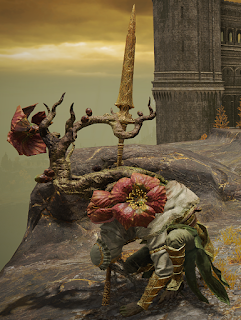
(I hadn't given my Crypt-Cities mini-setting much thought for over a year now. But somewhere during the lurid dream-quest that has been my first Elden Ring playthrough, I came across these guys.

Trying not to spoil much, they are undead guardians brought back to life by the miniature trees sticking out of their backs. Some are bare or budding, others are blooming, still others are suffering a fungal infection.

How could I not go back and write something similar up for CCs?)

Rot Blossom Beds

Ahh, here we are. Look upon this mound of rot and despair, all ye wretched Awakened.

This is the fate that awaits anyone who doesn't take the time to check their scabrous hides for sprouts at the end of the day. All that struggle, all that toil, all that Need doesn't amount to anything if you become just another mindless seedbed.

Fortunately for our demonstrational purposes, this poor wretch was taken by a less virulent strain of Rot Blossom. They're still doomed, make no mistake, but it affords us an opportunity to study it closer without fear of any of you lot succumbing- probably.

See here how the biggest growth erupts from between the shoulders- rot blossoms especially favor the spinal column as a pathway through the body when taking root. If this specimen was given the time to, it's likely it would grow into a hideously beautiful tree that would then spread its seeds all across the wastes, catching more Awakened and perpetuating the cycle.

It's almost enough to make you want to burn it, isn't it?

Of course that will only make things worse- for you, for the host, and for countless other Awakened. Instead, your best course of action will be to cut it down to size and then bury everything in pieces somewhere even more inhospitable than the rest of the wastes- a salt flat is ideal. Yes, you're damning your fellow to an eternity as an immobile salt mummy, but you'll be saving everyone else. Easy decisions do not await you in this unlife, Awakened.

See how the roots weave their way all along the body, even worming their way in under its death mask.  This allows it locomotion even after a point where the host's independent motor functions have long since ceased. The body is just another organ now, granting the plant the ability to move and see. The union is rarely perfect, and it can sometimes take seconds for stimuli to travel from one half to the other- that is what gives the rot-bedded their characteristic shamble; the thing so many of the Living characterize all of you having by default. It may be that these poor wretches originated that stereotype, but don't bear them any ill will for it if you can help it.

We may as well get this next part over with and show you lot how to neutralize them.

See how the body twitches and slowly gathers itself up as another creature approaches it. See the clumsy yet deliberate swivel as it tries to locate and react to this new threat.

See how it... waves its hand and clears its throat?

And... politely introduces itself?

What?


Not Just Fertilizer

It is difficult to call you "one of the lucky ones". You are an Awakened, after all. But considering the worse fate you should have suffered given the situation, it's safe to say you skirted another abyss. And look at you now; you've got a friend.

A less parasitic kind of rot blossom has taken root in your body. In fact, its relationship to you verges on symbiotic. You grant it life through your unfathomable biology, and in return it offers up its grim bounty. Perhaps it is a long-lost strain, or a more recent mutation. It may resemble a small flowerbed, a half-dead shrub, a tangle of vines, or even a gnarled sapling. Coloration ranges from matte and bland to eye-wateringly bright and lurid; texture from glassy smoothness to shredding thorns.

You resemble a Holt-Dweller whose mask has gone horribly awry, and among the unlearned you may even pass as one. But any Awakened worth heir smoke knows what you are, and will probably scorn you as such.

The plant will cause irreparable damage to your body if you try to remove it in its entirety, but you can prune it or keep it trimmed. Virtually every blossom bed that manages to keep the company of other Awakened will obsessively dispose of any fruit, seed pods, spore clusters, etc. before they can mature. Of course then you are left with company that is afraid of neither infestation nor immolation- a mad bunch indeed.

As alluded to, you can also use the 'bounty' of this bleak passenger to your own advantage. Branches can be cut and shaped into tools. Leaves can be harvested for their chemical properties. A seed can be used to hold yourself and anyone else in range of you hostage in a high-stakes situation. Your options are limited only by your imagination and recklessness.

You also benefit from something else. Something... disquieting to think about. You don't feel the Need quite as strongly as your fellows. The agonizing geas to throw yourself into a cozy little coffin in a crypt-city somewhere certainly still exists, but it doesn't have quite the same edge that drives others mad. This allows you to willingly travel farther afield of your final destination, opening up more opportunities to find resources and dangers out on the wastes.

But why exactly is the Need weaker in you?

Is it the rot blossom? Does it shield you from it?

Or is it feeding you a conflicting urge so subtle that you can't even perceive it?

And if so, where would it lead you?

Sunday, August 16, 2020

Lamplighters: Darkness

"Intan, shine your spotlight over toward that mass over there please."

"What the hell is that, Doctor?"

"An umbral mass that is undergoing the final stages of absorption."

"What did it used to be...?"

"It could have been a cow. Or a freight train. It gets difficult to tell. Come this way now, please."

- Radio chatter from a routine field work assignment at the Elu Igwe Land Reclamation Front


 "All that is, is kith and kin. All is stardust. As moon reflects sun, we reflect moon.

Darkness gave way to light, absconded with it, and shall yield it again soon."

"Prayer against the Dark", Kith of the Moon


The human instinct to fear the night once served a valuable role in self-preservation.

Now, with darkness ever-present and deepening, it is perhaps humanity's greatest distraction and detriment.

Learning to temper one's fear of the dark with a healthy amount of something else--stoicism, hate, prayer, professionalism, the list goes on--is a vital lesson that no one grows up without. Even in the heart of a settlement's pallite processing facility, the dark is never very far away. Exhausting, miserable vigilance is the only way forward, even if "forward" only leads to a slightly more delayed death.

Of course, one can't get along with plucky determination alone. One has to know the enemy.


Qualities of Deeper Darkness

Everyone learns about the mechanics of that which perpetuates the Long Night differently. Some lucky enough to receive a formal education are taught about its dangers in the form of lectures and texts. Most learn more informally from parents or other community members growing up. A few learn firsthand, and a few of those even survive.

Deeper Darkness (DD) is a phenomenon that breaks most previous understandings of physics, thermodynamics, and a slew of other fields in ways that are still being accounted for, decades after its first appearance. This has not stopped certain, more practical pieces of information about it from becoming common knowledge today, fortunately. What little is known about is as follows:

It is Spontaneous

DD does not appear to stem from any single source. Any shadow, if left undisturbed by light for a long-enough period of time, has a chance of generating a patch of DD. Controlled experiments with pallite cannons have concluded that the probability of DD generation increases exponentially over time until it reaches 1.

The speed of this increase varies considerably depending on circumstances that are not fully understood yet, but which likely include preexisting local DD density- this is why it can spread rapidly in trackless wilderness, but is relatively manageable when it appears in an untouched storage room in a populated area.

On average, DD can manifest anywhere from minutes to weeks in a darkened area. Shining a light upon a darkened area, even a low intensity one, is sufficient to reset the clock on generation so to speak. Only sustained, direct bombardment by high intensity light can dispel DD once it has accumulated in an area, however. Exact brightness varies, but a general rule of thumb is that the ideal "scrubbing" light has a high enough luminosity to blind operators without proper protective equipment.

The task of keeping every surface within a space illuminated or scrubbed regularly enough for it to remain habitable is a major preoccupation of the vast majority of human beings at present. Pallite light arrangements need regular maintenance, and demands for energy efficiency encourage the use of claustrophobically small spaces with sparse furnishing. Major settlements often have enormous custodial departments specially trained to remove and prevent domestic DD deposits.

It is Palpable

Describing DD as "caking" over things or requiring "scrubbing" is not an elaborate extension of metaphor. It is an actual, physical thing. It can be interacted with in a range of ways, including not only the visual, but also the tactile, olfactory, and (highly discouraged) gustatory senses.

Observing samples of DD for full knowledge of its physical properties is a challenge, because the light-absorbing properties of DD renders almost all known areas of the spectrum unable to penetrate its aura or 'halo' of anti-illumination. This halo of darkness extends beyond the physical body of a DD sample by anywhere from several millimeters to meters, depending on size and relative strength of its steeping. Pallite is one of the few forms of lighting known to penetrate the halo and reveal what is underneath.

Prolonged exposure to pallite causes DD to deteriorate over time. (Un)fortunately, the world is in no short supply of DD samples, and most lab technicians need only walk a few meters beyond their settlement's safety fences to obtain more.

DD in its natural state superficially resembles a severe mold infestation growing upon any surface. Large, spot-like structures radiate outward into smaller and smaller blotches in uniform fractal patterns, forming a pulpy, fibrous carpet that ranges in thickness between a few millimeters and several centimeters deep.

It is tough and slightly spongy to the touch, difficult to damage in any meaningful way with small arms. It is also extremely flame-retardant, mitigating the effectiveness of controlled burn methods used for containment.

The color of DD is so uniformly black that it looks more like a hole in reality than a physically present thing. This is due to the fact that it absorbs ~99.9998% of all light across the visible and most of the invisible spectrum.

Prolonged exposure to pallite causes DD to stop expanding, shrink, and 'die' so to speak. Its halo diminishes, and its spongy growths become weak and brittle, like a dry old insect hive. Larger structures slough apart, and with enough concentrated illumination, any trace of it other than leftover scars will sublimate into apparent nonexistence.

The general consensus is that DD has a smell, but what exactly that smell is depends upon the observer. Some accounts describe it as one or several smells of rot and decay, burning plastic, bleach, or a particularly cloying, artificial fruit candy scent, among others. These smells may be due to the breakdown of the matter that DD has grown over, rather than a product of the DD itself.

Dubious reports claim that DD tastes like the color purple. Subjects who taste or ingest a sample are rarely able to articulate the flavor more fully than that before rapid infection and fractalization sets in.

It is Mobile

DD 'grows' at a constant rate unless checked by pallite illumination. It can attach to and spread over any surface, whether organic, inorganic, living, inanimate, or artificial. Some of this new mass can be accounted for as previously belonging to thing which DD has broken down, but most appears to be continued spontaneous generation of matter.

Like the rate of spontaneous DD generation, the speed of DD growth is highly variable depending on environmental conditions. Growth is fastest within the halo of an existing mass, and slowest within an area of shade that is entirely surrounded by pallite.

Minor domestic growth can be managed on a daily or even weekly basis, but objects left unattended within areas of wild dark are rapidly enveloped. Caravan vehicles that have gone dark have been observed to become caked within a matter of hours.

Lingering pallite radiation seems to slow the growth of DD. This is supported by evidence of Lamplighter lamp-wagons taking days to fully succumb to envelopment, even after running out of pallite fuel. Pallite miners and Lamplighters themselves, living or dead, have been known to possess a sort of "resistance" to DD growth, remaining incorrupt after hours of prolonged exposure with minimal protective equipment.

DD particles suspended in the water or air large enough to sustain DD can also turn into micro- or macroscopic orbs of darkness, ensuring that danger and limited visibility are three-dimensional and omnipresent within areas of sufficient steeping. Drinking water must be run through pallite filters, as does air in any facility with extensive ventilation shafts that could house patches of darkness.

Atmospheric conditions and prevailing winds permitting, clouds of airborne DD particles have been known to form and blow across the land, distributing DD across a very wide area. This phenomenon is known by the unoriginal but sufficiently ominous moniker of darkstorm. Darkstorms are extremely dangerous, and are one of the leading causes of settlement compromise and loss of reclaimed territory. They resemble sandstorms or blizzards of black snow, and have been known to consume entire kilometers of illuminated land in a few hours.

It is Corrupting

Deeper Darkness does not fit most definitions of what constitutes a living thing. Some have compared it to a slime mold or even a virus, but it does not reproduce or depend upon hosts, nor does it "eat" in any conventional manner, regardless of what it seems to do to living tissue that it absorbs.

Regardless, it sometimes behaves like a living thing, or perhaps a force of nature that trends toward an end goal of expansion and absorption. Considering its antagonism toward the human species (alongside just about everything else in the world), it is all too easy to ascribe a malevolent intent or intelligence to the darkness. The topic is subject to extensive debate across many fields, and is beyond the scope of this piece.

When DD interacts with matter, it breaks it down into its most base elements and adds those elements to its own mass. At some point in this process, those base elements are converted into more pure DD. Even after being subject to illumination, no trace elements of absorbed matter can be found where a DD sample had once been. How exactly this conversion process occurs is not known.

Living tissue is not spared by this process. It breaks down all the same, causing severe damage to any organism infected with DD as it expands across and throughout the body. Bodily trauma is inevitably fatal unless the infection is quickly neutralized by pallite illumination and radiation bombardment. Survivors are known to bear deep, sprawling, fractal-shaped scars which are prone to act as sites for spontaneous generation, and therefore reinfection.


Early stages of DD tissue damage.
Subject I-82 of the Lavada Project.
Limb later amputated to prevent spread.

Infection can occur from prolonged bodily immersion in darkness, or from direct contact with DD, even under controlled conditions. Ingesting contaminated food or water, or breathing air with darkstorm particles in it, can lead to a far rarer form of internal infection.

The exact effects of internal infection are poorly researched compared to pallite poisoning at this time, but is believed to be rapidly and uniformly lethal, with organ failure the leading cause of death- euthanasia at the first sign of alveolar or lymphatic fractalization is recommended by the ethics boards of most leading medical institutions.

Darkness does not always kill, at least not immediately. Sometimes the rate at which it breaks down a host animal is slow enough to afford the organism hours or even days of in-tact motor functions and at least some mental faculties.

The near-universal violence and aggression displayed by these individuals can likely be attributed to mental stress caused by intense, nonstop pain. Their tendency to seek out sources of light may be rooted in a lingering association of light with safety, despite the fact that immersion in light causes harm once enough of the body has been assimilated. Their resultant efforts to smother light sources can therefore be interpreted as a misguided attempt to reach that safety.

The fact that infected organisms rarely attack one another, and instead make concerted efforts to attack uninfected individuals using a vast array of spontaneous mutations and bodily abnormalities, up to and including destroying light fixtures from afar, is not so easily explained.

Friday, February 21, 2020

Crypt-Cities: The Greenherders.

Islands of Green in a Sea of Death

You wouldn't expect there to be much of a rapport between Nomads and Holt-Dwellers. Their borders were fluid yet haphazard and cause for tensions for centuries, and that was before the curse of the Awakened gripped the land, before your kind started shambling about and the soil started to die beneath their feet.

And for the most-part, no, they are not on very friendly terms.

But that didn't stop a handful of them from working together when the world began to die.

At first, it was just a couple of the Dwellers who were desperate to move to a healthier tract of forest. The old growth had been dying away, allowing the Nomads to expand their grazing territory. The green-wardens bought their way into a traveling band, who brought with them dozens of wagons laden with plant life. Pots, sacks, and entire troughs of rich, black earth housed hundreds of shoots, sprouts, saplings, and other young green lives desperately trying to grow. When the waste-wanderers dropped them off at their destination, they were given a few choice specimens in payment.

Over time, more nomads gave more holt-dwellers transportation and protection, particularly when an entire community was suddenly cut off from the rest of a forest by sudden natural or unnatural disaster. Some were small affairs, while others saw entire trees uprooted and safely replanted. Something of an understanding formed between the two peoples, and cultural exchange grew deeper.

It isn't entirely clear when the plants started walking themselves.

Maybe some of the old wood-shapers started to meddle in few fields of esoteric knowledge, or maybe they'd always had access to it.

What is known is that a few hundred years ago, the transitional grass belt became populated by mixed bands who herded both animal and plant. Simple words, lassos, and crooks were enough for the beasts, but it took a special kind of magic to coax a shrub into uprooting itself and squirming forward under direction on roots like so many clumsy, twisting legs.

Over time their art was honed and perfected. Soon, trees could drag themselves along by their roots. Before long, entire groves would walk or stumble at the lead of these Greenherders. They were far slower than draft animals, but comparatively implacable so long as they had water to store and good soil to root in at the end of a journey.

It was a natural conclusion of the process to weave them together. Roots not needed for movement were made to knit themselves together into vast meshes which could hold and bear the weight of good soil. Specialized roots bored deep into the earth to tap increasingly hard-to-find groundwater reservoirs. Over time this practice was strengthened until earth, stone, other plants, and even pools of water could be carried by these increasingly large agglomerations of flora.

They could even be inhabited.

Rather than subjecting them to the harsh wastes, the herders loaded their animals up onto a bed of animated earth before every major migration. The dead, human or beast, began to be buried amid those groves so that their every element could benefit their nascent ecosystems. Villages were built on the backs of those groaning forests, entire generations living and dying within view of a wasteland which they were almost able to separate themselves from entirely.

But as the earth continued to wither and resources stretched thin, the greenherders split up. Their bands ranged far and wide, each adapting to the strange and unique hardships of the region which they ultimately found themselves in, following the old paths known only to the Nomads. Roots dug deeper to pursue the fleeing water reserves. Vines as fine as hairs with fingers like cilia cling fiercely to soil for fear of losing a grain. People once at the forefront of a sociable, trans-cultural exchange have become reclusive and wary.

Now, it is vanishingly rare to see more than one or two of these walking green islands in a lifetime.

But when you do, it can be such a sight.

walking island by CoconutMilkyWay


Rot Blossoms

In their quest to become as resource-efficient as possible, a few more unorthodox innovations were made by the greenherders. Simply feeding the dead to the land is rather tame, after all- even if the idea is horrifying to the Awakened.

Their botanists hazarded to guess that a whole body could be made to benefit nature just as much as all its parts. So, they cautiously adapted plant life which could root itself directly in dead flesh without waiting for fungi and other decomposers to break it down first. A few relatively minor mishaps occurred in which calipers and pruning sheers became surgery implements and personal grooming tools, but before long the greenherders enjoyed hauntingly beautiful success.

Cropped from an image by Lora Zombie

A myriad of different plants were raised to grow from decaying flesh, but over time the umbrella term of "Rot Blossom" caught on and stuck. Normally innocuous elements of greenherder islands, Rot Blossoms have taken on quite a different character among the pained, raspy whispers of the Awakened worldwide.

You know them well, don't you? Bet you hate to hear someone confirm that all of the rumors are true, huh? Quit your knee-knocking and pay attention before you break a joint.

Yes, Rot Blossoms can infest the Awakened.

Your flesh may be animated, but it is most certainly decayed. And the slower rate at which you decay actually makes your kind an ideal bed for some of them. They can take root and lazily drain the nutrients from you until there is nothing left of a husk, unable to move as it overtakes your entire body in its sweetly sick tendrils, left to wait for some unlucky scavengers to happen upon you and start the whole cycle over.

Of course these aren't the ones to be feared. You can simply avoid their little boring seeds, or rip a sprout out long before it could suck you dry, resulting in minimal damage to your carcass.

No, you need to fear the ones with minds of their own. The ones released into the wastes by accident, never intended to be used on the Awakened- and therefore the ones without any well-known guards against them. The ones with the same walking-roots as the titanic green islands, but on a minute scale. The ones whose seeds can fly in on the wind, land on your shoulder, and then worm their way into your ear canal. It's just a few finger-widths of wriggling from there before they hit your rotten brain.

That's when the fun starts.

It can take over what little is left of your motor functions from there- subtly at first, of course. You'll think it's you deciding to go this way instead of that, or to lie down in the sun with your head tilted just so, despite never having done so before. But over time its control will grow more overt and difficult to resist without inflicting massive, potentially debilitating trauma upon your own skull.

By the time the first buds erupt from behind your death mask to bloom in the parched air, you'll be powerless to do anything about it.

If you're lucky, you'll have fallen for its intoxicating presence by then, and won't really mind.

What's that? 

Of course you will still be conscious.

Not even burning to ashes can fully kill you, so why would a little decomposer-turned-parasite?

With no heed given to the ever more agonizing pangs of the Need to find a crypt-city, it will lead you far astray. But it won't force you to do it alone, oh no. It knows an ambulatory host is better than a still one, and it has no use or interest in healthy, living bodies. So it will make you bring it to other Awakened, in order to grant its seeds to them. And other Awakened will come in search of you in turn, either to destroy you if they have the sense to, or to join you, damn that alluring reek.

There are tales of truly pungent flower beds tucked away in the ruins of the world; rumors of fallen crypt-cities overgrown with this aberration of nature.

Rot Farm Skeleton by Maciej Kuciara

Tuesday, January 21, 2020

Goblin Brain: Veterinarians Can Send Your Pets to Valhalla


I... don't know why I insist on starting every one of these audio posts with such a pained, drawn-out "I".

Hello, dear Burrowers, if there are any of you out there still. My apologies for vanishing again.

I'm still alive! Fortunately my Narblesnard went as well as can be hoped, and my acorns were enough to sate the squirrels this year.

I had myself another bit of a spiral over here, which coupled with the cold weather to ensure that I wrote nothing and wanted to write even less than that. But I'm still breathing, and doing things like making phone calls and reorganizing my bedroom to maintain the illusion of having meaningful control.

You can rest easy, or alternatively become annoyed to know, that I will be returning to periodic posting again soon, and that they will be far more relevant to my blog than these Goblin Brain episodes. I'm just tacking this onto one because it is a very overdue draft that was sitting on my dashboard... among thirty or forty others.

So, stay warm out there, depending on your hemisphere and particular climate, and thank you for listening.


I've never technically owned a pet.

Of course I've lived in a house with pets whom I interacted with, past and present.

And on at least a few occasions I've been mistaken for a pet, though that's a story for another time.

Or, probably not, actually...

Anyway!

I've never technically owned a pet. They've always belonged to my parents, and they've always been the ones chiefly responsible for all of the duties that pet-having entails. Not from a lack of willingness to participate on my part, but because my parents always found it easier or at least simpler to just do the things by themselves rather than teach me and set me up to do them properly after that period. Like they had a unique, noncommunicable technique for cleaning out the litter boxes, or for changing the water in the fishbowl, or what have you.

I think they did a lot of similar sunk-cost calculations with regards to my upbringing, come to think of it...

Lacking any real responsibility for the pets we've shared our home with over the years, I probably had a markedly different relationship with them than normal, er... goblin children do. Coupled with the fact that all of our cats, or a full two-thirds of the pets we've owned, were strays we took in and fixed up, it's always been the norm for me to have an awkward, distant coexistence with pets.

Like having a roommate who's always twitchy and nervous and might scratch you, and vomits a little too frequently on the carpet.

Even so, I came to befriend our last batch of cats a good deal.

We currently have a psychotic female tuxedo cat, but a year-and-a-half ago we also had an overweight female longhair, and a gingery, neurotic male tabby. They came to us at different times and ages and had vastly different personalities that lent themselves well to inventing bizarre voices for, as pet people are wont to do. Some of the most amusing conversations to ever go on in our house were done through the cats.

(People do that, right?)

I had an affinity for the tabby in particular. He would claw his way into my bedroom to demand obnoxious amounts of pets from me. We would bunt by headbutting at the dinner table often. I was usually the one to voice his persona. For the record, he was a clueless, blustering, but well-meaning old man from NYC's Lower-East Side who had a tendency to barge into the room to incorrectly correct someone's pronunciation of a word, make a lousy pun, or beg for ham.

My mother jokingly said he was my little brother.

He was the first one to be euthanized, in autumn of the year before last, if my memory still serves me. Conjunctivitis from scratching himself in the eye, and necrosis of the jaw tissue from us being poverty-stricken fools who didn't know enough about cat dental health to take him to the vet we couldn't afford often enough.

I wept like a family member had died. I suppose one did.

Our big, tubby, stupid sweetheart of a longhair went a few months later in the winter, due to a combination of the condition apparently known as megacolon, and--you guessed it--poor dental care.

It hurt just as much, but my eyes were drier that time. It felt like I didn't have the right to mourn, not while my mother and father were despondent and angry with guilt.

We'd made a friend in the vet who looked at both of them, though. A young, tall man, fabulously flamboyant man, who'd done everything in his impressive ability to fix our mistakes for both cats. He was saddened, but also consoled my parents for making the right choice in putting each of them down when those days came.

It was likely at his urging that the vet staff all got together to sign a card specifically designed for the occasion of dead pets. I didn't know those were a thing.

I also didn't know anything about those apparently well-known poems from the '80s and '90s about pets entering into heaven by crossing a rainbow.

The poem we got for our tabby was like any of the others, well-meaning and stomach-achingly saccharine. Our cat had apparently entered an idyllic meadow fully restored to health and happiness, among many other former pets, all waiting at the foot of the rainbow that bridges the gap between earth and the afterlife. When the owner finally dies, they're reunited for good, and make the crossing together.

Of course, being the mythology nerd that I am, I had a very different context for a poem involving a "rainbow bridge".

I immediately pictured him stepping onto the Bifröst, schmoozing his way past a bemused Heimdallr, getting lost in his wanderings through Asgard, and eventually winding up at the feet of Freyja in Fólkvangr. Sure he'd be too small to help pull her chariot, but he could tag along anyway, and the skogkatts could show him the ropes before long.

It was a comforting thing to pretend, even if it was only that.

Monday, March 18, 2019

Crypt Cities: What the Dead Carry.

Really?

Grave robbery?

No, that term is too dignified for what you propose. Corpse pillaging is what this is.

Were you listening to anything? Are you aware of the things your fellow Awakened have had to suffer through? The sanctity of one's death mask? The difference between collapse and perseverance embodied by the smallest of trinkets and sentimentals on one's person?

You are, and you just don't care?

... Smart. You'll go farther than most.

When one of you has just about had it, and all seems lost, the embrace of true death nonetheless remains elusive. Instead, you crumple under the weight of the Need as well as your own personal anguish, and turn inward. Without a body strong enough to carry you to a sarcophagus, your mind turns inward and consumes itself, slowly. You can look forward to weeks, months, even years as a tormented Husk, trapped inside of that desiccated head of yours. And after that, when you start to fall apart at the molecular level, the real fun begins.

Some of the damage can be reversed, if you were to be placed within an enchanted coffin of your own.

Of course most of the other travelers who come across your bleaching hide will be less interested in picking up and helping you, and more interested in helping themselves to the pickings of whatever you might have had on you when you went catatonic. If you're smart, you'll keep your eye-slots peeled too.


(Roll 1d40 whenever you come across a suitably lethargic-looking cadaver. Any rerolls ignore the same result twice in a row.)

1
Nothing But Dust
The Husk and any rags it has left fall to ashes at your touch, its mask crumbling into nothing. Have a moment of silence for this most grim of fates.
2
Tattered Clothes
Little more than a filthy, stained loincloth. Gain one rag. If you are feeling particularly brave, gain one bandage or article of clothing.
3
Encrusted Thing
This object is completely covered over in gunk, grime, or dirt. You have no idea what it is or does. Gain one crusty old... something.
4
Vile Trophies
This Husk must have been one sick puppy to collect all these. If you are not Hunted, become mildly unsettled. If you are Hunted, have a laugh.
5
Abused Rucksack
Spacious, but weakening in places. Gain a medium-sized container. If it is ever filled to capacity, it ruptures.
6
Ghostly Whispers
You find nothing, and the murmur of wind and ash fills you with a sudden, dreadful urgency. You suffer one additional day of Need.
7
Scavengers
Carrion-eaters and worse things have found the Husk before you did. If you fight or scare the competition away, reroll.
8
Noose Necklace
A piece of fashion commonly sported by alumni of gallows the world over. Gain one short length of rope.
9
Snipped Sinews
Several of the Husk's muscles are still good. Gain three uses of stitching, or one bowstring, cord, garrote, etc.
10
Old Child's Toy
A weathered wooden figurine or a threadbare doll, probably kept as a memento. Gain one bitter reminder of your own lost youth.
11
Rendered Human Fat
A jar full of fragrant adipose tissue. Gain five uses of fuel or oil, and attract predators at twice the usual rate.
12
Visceral Trail
Dried droplets of black ichor, the lingering reek of death-smoke, and the occasional severed limb point toward potential danger- and profit.
13
Shiny Rocks
Not even the dead are exempt from humanity's fixation on shiny things. Gain a bargaining chip.
14
Befouled Liquids
These vials or skins once contained valuable potions or life-giving water. Now they are spoiled and noxious. They make you nauseous to drink, but could be used as a stink bomb or olfactory concealment.
15
A Fistful of Coins
A few ancient coins of unclear mint and composition. Flipping them into a body of water and wishing might do something. Like poison the water.
16
Corpulent Swelling
Jostling the Husk causes its abdomen to burst and shower you in insides which quickly become outsides. You can be smelled from a much greater distance until you bathe.
17
Awful Poetry
In sanity, this Husk used poetry as a creative outlet and coping mechanism. In catatonia, it serves to make you groan. Gain one use of fuel.
18
Powdered Herbs
They might have been an apothecary's wares. Or an old pressed flower collection. Gain two uses of medicine. Or placebos. Or poison.
19
Rusting Fragments
Anything made of metal such as weapons or armor has long since broken, but the pieces remain. Gain one use of scrap.
20
Infestation
At some point this body became host to a den of vermin or a squirm of large parasites. Gain one ration of food.
21
Infested
At some point this body became host to a den of small vermin or a squirm of large parasites. Now, so have you.
22
Old Wagon Wheel
Some Nomad cart won't be going anywhere without this. Gain a shield that breaks after deflecting three blows.
23
Mimicry
That isn't a Husk. That isn't even humanoid. And whatever it is, it looks hungry.
24
Gnarled Branch
Someone tore the face off of a particularly old Holt-Dweller, but didn't get around to working it yet. Gain one piece of wood.
25
Weaponized Femur
Whoever this belonged to must have had legs like a workhorse. Treat as a club that breaks after five successful hits.
26
Old Bone Dice
Bones for throwing, and a bit of idle recreation. They're probably not cursed.
27
A Ghost of Warmth
For the briefest of moments you feel faint, pleasant sensation that you'd thought dead for ages. Nothing about the Husk or its possessions tells you why or how to replicate it, however.
28
Crypt-City Brochure
An old flier both advertising for one of the smaller, newer Crypt-Cities, and calling for the violent expulsion of all Awakened. If you become lost, you may reorient yourself toward your goal once.
29
A Spare Limb
Everything seems to be in working order for one of the Husk's extremities. Randomly gain a spare left or right arm or leg.
30
Dislodged Corpse Nail
This foot-long wrought iron spike is hammered into the limbs and torsos of the Awakened by Hunters to affix them to a Groaning Pillar. Treat as a dagger.
31
Moldering Pages
Scraps of some old tome or journal. They may offer some insight into local dangers or past travelers.
32
Rot Blossom Sprout
Run. Run as fast as you can.
33
Sandals!
A marvelously underused pair of sandals. Gain the ability to travel the Wasteland in almost-comfort for the next hundred miles.
34
Passage of Death-Priest Psalms
These grim old hymns allow you to reflect upon your struggle and the goal which lies at its end, bolstering your resolve. You may ignore one day of Need.
35
Looted Mask
This Husk was once another corpse-pillager like yourself. Gain one blank death mask to use as a backup, and don't dwell overlong on this glimpse into your own future.
36
Map Fragment
Manic scrawling making use of parchment and ink of questionable origins outlines the general area and points of interest.
37
Mystery Cult Trinkets
Ritual tools and artifacts of ambiguous design and purpose. Using them correctly might allow for the casting of a single spell. Or they might explode.
38
Black Marrow
The bones of every Awakened become imbued with a hint of death-smoke essence over time, and these are still juicy. Become well-rested, if you can tolerate the grizzly, selfsame feast. Just ignore the nightmares.
39
Smoke Pocket
A pocket of death-smoke hasn't yet left the Husk's body. Split open the bubo-like protrusion in its flesh and huff deeply to repair light damage or remove one minor debilitation.
40
Not A Husk!
The corpse you're scavenging isn't entirely catatonic yet! Take light but unavoidable damage as it suddenly bites and flails mindlessly at the rude awakening.

Saturday, January 12, 2019

Crimson Honey (2/2).

Click here for Part 1.


I keep scooping.

The crying recedes into the distance. The mists begin to close in around the riverbank once more, choking the sounds around us except for our own groaning. Most of us stop shaking, and the river reeds take our place.

I keep scooping.

I see myself, and my mother. I am young, and she is not dead yet. She hugs me, and I fling myself from the side of a cliff. The skin on my back peels away--more than it already is--and I sprout wings. I claw out the eyes of the village boys, and then I fly to where the rivers pour out of the sky. The water smells like dog.

There is a hard crack, and this time the pain throbs inside of me. I lean over and cough. Fragments of tooth litter my lap. The molar finally finished crumbling. I rub some honey against the hole. It bleeds, but the blood mingles with the honey and I stop noticing.

The crying stops, but something else takes its place. The sound of wind, and churning water. The branches weeping over the river flail and bend, making way for the mist as it flees back down the current. I turn my head, and I can see the boat over my shoulder, naked and still in the waters. The pale man is speaking now, and the laughing man is arguing with him over something. They thrust their poles into the riverbed, but the boat doesn't budge. They strain and push. The aft end rises up and the prow dips, but they go nowhere. I see clutching, scrabbling little things clinging to the bottom of the boat. They look like waterlogged hands, and overgrown fingernails.

I hesitate, and keep scooping.

The wing blows harder, howls louder, and we hunker down and cry, or shout and leap up into it to be bowled over. The trees bend and rattle, and people are screaming in the village up the bank. My hands squeeze tightly around the jar, and I hold it to my heart.

Then everything is still. The wind dies. People lift their heads again.

There is someone else out on the river. He is looking at the men in the boat. But he is not in a boat. The surface of the water is breaking beneath his bare old feet, and gnarled bones are clutching at them, propping him up. He is wearing faded old green and blue that blinds me to look at, and his staff is as black as a yawning pit in the earth that I could fall into. He lifts the staff up, and the men in the boat start to shout or move. They do not finish whatever they are doing before the thunder cracks.

His staff hits the water, and it splits open.

The boat splits open, and the chest splits open.

All of the jars come crashing down into the hole in the river, and we hear the shattering of glass beneath the splintering of wood. We hold out our hands and cry in anguish. Some of us that can still walk leap down into the shallows and try to wade out toward the red-dinged water. More grabbing little things reach up out of the silt and stop them, hold them, and keep them from thrashing.

The laughing one and the pale one are clinging to the sinking halves of the boat. They are shouting out and cursing at the man now. I do not see the man that they were taking away any longer.

He breaks his silence, and the boom of his voice makes my ears throb. He speaks like us, but he is not like us. He looks like the old grandfathers in the village, but he is not bent by time.

His eyes are so bright.

They hurt the most to look at.

I stop scooping.

One of them swings a pole at him, and he raises his hand to meet it. The wood cracks in half and splits down the middle, and the laughing man falls down into the water with a shout. They are all yelling now, but the wind and the river grow louder. The current swells, and a wave rises up to scatter the last pieces of the boat. The laughing man and the pale one cough and sputter, and climb up onto the bank. They drag themselves into the forest.

The water glints and glimmers with honey and coins until they all wash away.

The old man is looking at us now. He is dragging the honey-drinker by his collar as he walks across the bones in front of him. He is coming toward us, and the hands in the shallows stop grabbing at us.

But they take our jars with them. Bony fingertips and split nails scratch over the glass and clay and pull them into the earth like it was sand, and we bloody our hands trying to dig them back out of the dirt.

I try to pull a root out of the way, but it is too deep, and my knuckles feel like they are going to pop. My face is wet now. I am sobbing into the dirt.

The man is standing over me when I look back up.

He is tutting at me, but he is smiling.

He says he is sorry that he has arrived so late. That he will do what he can.

The swirls start to fade from behind my eyes, leaving only the blur of my tears, and the pain comes back. It hurts less than it usually does. I can lift my arms when the old man extends his gnarled hand.

I take it.

Sunday, October 28, 2018

Crypt Cities Encounters: Forsaken Flesh.

As fleeting and meaningless as it is in the face of an eternity of Need or waking oblivion, many of the Awakened try to resist the draw toward the Crypt Cities for as long as they possibly can. This is easiest for your kind to do when there is something to cling to, and to pour yourselves into entirely. For some it's a craft or art, or revenge, or faith. Vices are difficult to come by when the senses are so deadened, but you'd be surprised at what desperate souls have been able to find.

Surprised, and horrified.

Hedonism is a rare but particularly cruel poison to the Awakened. The absence of physical pleasure should mean that the pursuit of it is pointless, and this is mostly true. But that doesn't dull the ferocity of a few acolytes desperate to indulge in any feeling. Tucked away in the moldering warrens of cities, deep forest glades, and abandoned mountain crags, these secluded groups--hidden for no other reason than the lingering ghost of their own shame--attempt to sate their artificial fixations. To call it sadomasochism would be inaccurate, for that tame little novelty of the living is outstripped by what they do to one another and to themselves.

Still, at least those groups tend to disband within a few years, their members finding that nothing dulls the Need for long, or the unlucky becoming addled and lost.

At least they don't succeed.

Once upon a time, several centuries ago by now, there had been plans to develop a new Crypt City closer to the seas. This distant annex was probably fated to fail anyway, or at best reach overpopulation within a scant few years. But it never got that far along in its construction. The workers began to be attacked or driven off, and more than one masked priest was hacked to pieces and bled of all of their smoke before the site was abandoned. A massive structure still stood there from what work had been completed, lonesome and stark against the wasteland around it. All the interlopers had to do was move in.

Within the failed crypt, the halls were gutted of their sarcophagus alcoves, and the central chamber was enlarged massively. A deep pit was dug in the center, and an amphitheater was built which would house them and everyone drawn to their cause. In the embrace of withered arms, hundreds found love and searing agony. But instead of petering out into another forgotten old distraction, some terrible threshold was breached.

Maybe one among them had been a truly gifted user of the astral or arcane in life. Perhaps some thing beyond our ken had been watching and waiting for an opportunity. It isn't clear exactly how, and perhaps that is best.

What good could come from learning how their flesh separated from their bones in one final, debauched orgy of decay?

Ounce by ounce, their beings sloughed apart, leaving slick skeletons rattling through the corridors or around the edges of the pit, mindlessly repeating the last actions which their former owners had been performing when the Embrace happened. It started as a pool, and then grew hideously in size, piling up on itself, moving, breathing with the life of everyone who had gone into it. Like a shuddering, mewling tumor it grew to fill almost the entire amphitheater.

And there, centuries after it should have rotted away to nothing, that mound of Forsaken Flesh still churns upon itself. It calls out with hundreds of voices, begging for others to come and join their embrace, to feel their piteous love, and to add their human dregs to the mass.

Sometimes its calls are answered, either by those seeking to add their voice to it, or those who would silence it for good.

In either case, they tend not to be heard from again.


Domicile of the Forsaken Flesh

This unfurnished basalt edifice was once meant to be the core of a new Crypt City. From its domed center extend four wings, each one oriented toward the cardinal directions, but slightly skewed to one way or the other. It is entirely windowless in the traditional Crypt style, though the interior may occasionally be lit by a hole in the roof or walls caused by the slow dilapidation of the entire structure. Hallways extend in all directions within, mimicking spiderweb patterns meant to maximize the "living" space of the death priests who would have presided over the City and its occupants. All paths which remain intact lead toward the central chamber.

Forsakers

Stripped of all skin, muscle, and sinew, even hollowed of all their marrow, the bones of the old celebrants still walk the halls of the Domicile. It is unclear if they now serve the Flesh, or if they are still possessed of enough of their old selves to recognize the vile thing they contributed to, and wish not for it to be seen or added to. In either case, they will attack intruders without hesitation, breaking their otherwise mindless routines to attack with whatever is at hand- including the discarded bits of their fellows.

Free the Imprisoned: If a Forsaker succeeds in grabbing a hold of its target, it will proceed to tear at any flesh left on it, dealing unarmed damage. If its target is incapacitated--or more rarely, the target is a genuinely dead corpse--the Forsaker will strip it to the bone in an attempt to free the skeleton within. It is not clear if they are aware that this does not have the desired result of animating the skeleton most of the time. But rarely, a skeleton so flensed will stand back up, and appreciatively join its new kin in rattling vigil. It is seemingly random whether the Forsakers discard any resulting meat, carry it back out of the Domicile to rot at the doorway, or leave it at the edge of the Amphitheater to be absorbed.

Reassemble: The Forsakers do not stay down for very long. As soon as a day after its destruction, a shattered Forsaker will reassemble itself to be more-or-less as functional as it previously was, barring the loss of any bones which it cannot retrieve or replace. The oldest Forsakers are little more than swirling jumbles of fragments and bone meal.

The Amphitheater of Flesh

This massive, vaulted chamber holds up a weathered old dome which overlooks the central pit. Better sheltered from the elements here, trappings of the old coven can still be spotted amid the ruin. Stone carvings, fragments of pottery, and implements of unclear but probably unpleasant purpose abound. The flat stone floor is entirely bare around the edge of the pit, which is about one hundred feet in diameter and twenty feet deep. The floors and walls here are covered in a sheen of grease and flecks like what is leftover on a cutting board after preparing meat. Most of the pit is occupied by the Flesh.

The Covetous Singer, Forsaken Flesh

Massive, pungent, and possessed of both solid and liquid qualities, the Flesh is constantly moving. Sometimes its surface only churns or ripples, while at others it erupts into selfsame geysers which nearly reach the domed ceiling before raining back down upon the area and reuniting with the central mass. Vague suggestions of organs, vacant faces, or throbbing veins occasionally break the surface of its otherwise uniform melange of tissues. It sings with hundreds of different voices, each at an unsettling midpoint between bliss and agony. If attacked, it lashes out with countless ephemeral limbs, smashing and grabbing at anything within its considerable reach. It is not known for certain what could damage or kill it, but fire or exposure to the elements is as good a bet as any.

Seething & Slippery: The area around the Forsaken Flesh is difficult to navigate and maintain one's balance upon, being perpetually slick with all manner of bodily fluids. Yes, all manner.

Acquaint Thyself: A target which is touching the Flesh, or which is struck by one of its many pseudopods, must resist a sudden wave of dreadful nostalgia which comes over them. Failure causes the target to be lulled into inactivity, taking no actions and becoming incapable of moving or defending itself.

Come into the Fold: An acquainted target, if not removed from proximity to the Flesh, will be enveloped and held within its central mass for a full minute. If the target fails to shake off its addling nostalgia or is not removed with outside assistance before that time, it will be assimilated into the Forsaken Flesh. The target's voice joins the chorus, and a very scandalized-looking skeleton climbs up out of the pit and leaves after being unceremoniously spat out.

Wednesday, August 8, 2018

Going Downhill: The Pem-Pah, Part 3.

"Don't throw them back in. Not even if they have too many heads, or too few fins. Those we take back to the city. The priests burn them and don their ashes."
- One fishmonger to several apprentices, on the choicest picks of fish to bring to market.

"Like kneeling to adjust your sandals."
- A Pem-Pah expression arising from fisherman jargon, meaning to make a rookie mistake which results in immediate, often severe punishment.


The mid-range heights of Pach-Pah Yul are known for experiencing truly terrible blizzards, the valleys below avalanches, and the peaks above both freezing temperatures so low that no precipitation falls for years at a time. There is no denying that the rugged mountains are a challenging place to live, coupled with a periodic earthquake or the rare century's reacquainting with a dormant volcano.

But the shore of the Khaitam-po bay is another matter entirely. Storm and sea both make their presence known at all times at the heart of the Pem-Pah homeland. The most immediately visible is the former, taking the shape of unnaturally frequent lightning over the estuary and the water of the sea proper just beyond. Virtually every day and night, spiderwebbing crackles of lightning fill the roiling skies or shoot downward into the waters, ranging in frequency from once every couple of minutes to several times a second (according to the reckoning of those who make no use of the standardized taleck). The lightning has a range of colors as well, some of them allegedly very bright and lurid, and a particularly active show can be as captivating as it is distressing.

The cause for the lightning storms and the accompanying thunder is unknown at this time, and shall probably remain so. But the Pem-Pah believe that it is the manifestation of all of the hate and malice possessed by the dark gods of the world, directed toward their people in particular. Naturally for the Pem-Pah mindset, this is in the natural order of things, and a lengthy cessation of the Khaitam-Po Lightning is guaranteed to stir up native anxieties.

In the published journal of one truly adventurous tall-fellow, Basen of Meroth, we have a midsummer event dated to approximately B.R. 84 in which the lightning entirely stopped for a full day and a half, to the point that the sky cleared and stars were visible during the night. The shock to the nearby capital city of Anqoh was so severe that what Basen hoped would be a night of quiet respite turned into endless parading and ritualizing in order to bring back the ire of the gods. Without their bay as a focal point, they explained, the entire world would be ravaged and robbed of its sanity. As our sleep-deprived friend concludes, the return of the storms on the second day resulted in the tearful cheers of thousands crowding the desolate beach which rings the water.

Of course just as soon as they saw their job finished, they one and all sprinted as far up and away from the shore as they could, for the fishermen and keen-eyed among them were quick to point out how the lightning was now joined by something else.

They saw how the unsettled waters had suddenly become much more turbulent, and how the waves were now breaking with foam and bubbles as far out as the barrier between bay and sea. And so, keeping their necks stuck out high and faces upturned as a precaution, they retreated to the places above sea-level where they would not be in danger of the aptly named Killing Tide.

It is a truly insidious killer. Besides the bubbling of the water, it comes without warning. It is tasteless, colorless, and odorless, yet it is capable of wrapping around a person like a cloak and killing them without them even fully realizing it. Some take it to be the groping of angry spirits, released form a chasm in the underworld deep below the bay. Others, including theorists at Nambar or Deneroth (by way of ideas from Nambar), hold it to be some sort of heavy, toxic gas. Whatever it is, it seems to only have an area of influence about as broad as the shore, owing to its inability to reach much higher than five or six feet above the waterline.

This limitation, learned over centuries of hard trial-and-error by doughty fishermen, has been exploited to the safety of those workers, and to the benefit of the industry. Far more often than they are taught to swim, Pem-Pah fishermen are taught how to maintain and use a pair of stilts while working along the coast, or how to operate their small fishing vessels while tethered to  flexible poles thrusting up from their carefully balanced centers which are just long enough to elevate, but not long enough to make them more of a target for lightning than the occasional spike positioned across the bay. Just out of reach of the tide's influence, they are able to continue working their trade until such a time as it is safe to come back down- generally one or two hours after the end of the bay's bubbling are considered safe, depending on how chaotic the water first appears. Similarly perfected over the years is the art of determining which fish are safe to eat or not. Their catches are far healthier than one might think, suggesting that either the killing tide has no effect upon marine life, or that it rises through the water too quickly to harm them to a great degree. Nonetheless, they are also taught to look out for things which do not even meet a generous definition of the word "fish", and what precautions to take against those occasionally aggressive aberrations.

Through normalization and adaptation, the Pem-Pah are able to live quite ordinary lives in the face of truly great and terrible natural forces. Casualties to the storms or tides are either nonexistent, or remarkably low per year. The disposition of the land's people almost makes a stay in the place seem like it could be enjoyable in a challenging and thrilling sense, and I don't doubt that it could be for the right type of person.

But the consensus from people who have done just that seems to be that, no matter how muggy and buggy they are, the outlying villages and trading towns are preferable places to stay than in the scalloped monolith that is Anqoh.